


Portal:India


Introduction

.svg)
India, officially the Republic of India, is a country in South Asia. It is the seventh-largest country by area, the most populous country in the world and, since its independence in 1947, the world's most populous democracy. Bounded by the Indian Ocean on the south, the Arabian Sea on the southwest, and the Bay of Bengal on the southeast, it shares land borders with Pakistan to the west; China, Nepal and Bhutan to the north; and Bangladesh and Myanmar to the east. In the Indian Ocean, India is near Sri Lanka and the Maldives. Its Andaman and Nicobar Islands share a maritime border with Myanmar, Thailand and Indonesia. (Full article...)

 Featured article –

-
![Image 1 Kal Ho Naa Ho (transl. Tomorrow may never come, pronounced [kəl ɦoː naː ɦoː]), also abbreviated as KHNH, is a 2003 Indian Hindi-language romantic comedy drama film directed by debutant Nikkhil Advani, written by Karan Johar and Niranjan Iyengar, and produced by Yash Johar under Dharma Productions. The film stars Shah Rukh Khan, Saif Ali Khan, and Preity Zinta, with Jaya Bachchan, Sushma Seth, Reema Lagoo, Lillete Dubey, and Delnaaz Irani in supporting roles. Set in New York City, the story follows Naina Catherine Kapur (Zinta) who gradually falls for her visiting neighbour Aman Mathur (Shah Rukh Khan), but a secret prevents Aman from reciprocating his feelings, causing him to set Naina up with her best friend, Rohit Patel (Saif Ali Khan). Shankar–Ehsaan–Loy composed the original soundtrack and background score in their first collaboration with Johar, with lyrics written by Javed Akhtar. Anil Mehta, Manish Malhotra, and Sharmishta Roy were the cinematographer, costume designer and art director, respectively. Principal photography took place in Toronto, New York City, and Mumbai from January to October 2003. Filming was stalled for around six months due to Shah Rukh Khan's illness. The soundtrack was released on 27 September 2003 to positive reviews; the title song, "It's The Time To Disco", "Kuch To Hua Hai", and "Pretty Woman" were particularly well-received. (Full article...)](/criselda-https-upload.wikimedia.org/wikipedia/en/d/d2/Blank.png) Kal Ho Naa Ho (transl. Tomorrow may never come, pronounced [kəl ɦoː naː ɦoː]), also abbreviated as KHNH, is a 2003 Indian Hindi-language romantic comedy drama film directed by debutant Nikkhil Advani, written by Karan Johar and Niranjan Iyengar, and produced by Yash Johar under Dharma Productions. The film stars Shah Rukh Khan, Saif Ali Khan, and Preity Zinta, with Jaya Bachchan, Sushma Seth, Reema Lagoo, Lillete Dubey, and Delnaaz Irani in supporting roles. Set in New York City, the story follows Naina Catherine Kapur (Zinta) who gradually falls for her visiting neighbour Aman Mathur (Shah Rukh Khan), but a secret prevents Aman from reciprocating his feelings, causing him to set Naina up with her best friend, Rohit Patel (Saif Ali Khan).
Kal Ho Naa Ho (transl. Tomorrow may never come, pronounced [kəl ɦoː naː ɦoː]), also abbreviated as KHNH, is a 2003 Indian Hindi-language romantic comedy drama film directed by debutant Nikkhil Advani, written by Karan Johar and Niranjan Iyengar, and produced by Yash Johar under Dharma Productions. The film stars Shah Rukh Khan, Saif Ali Khan, and Preity Zinta, with Jaya Bachchan, Sushma Seth, Reema Lagoo, Lillete Dubey, and Delnaaz Irani in supporting roles. Set in New York City, the story follows Naina Catherine Kapur (Zinta) who gradually falls for her visiting neighbour Aman Mathur (Shah Rukh Khan), but a secret prevents Aman from reciprocating his feelings, causing him to set Naina up with her best friend, Rohit Patel (Saif Ali Khan).
Shankar–Ehsaan–Loy composed the original soundtrack and background score in their first collaboration with Johar, with lyrics written by Javed Akhtar. Anil Mehta, Manish Malhotra, and Sharmishta Roy were the cinematographer, costume designer and art director, respectively. Principal photography took place in Toronto, New York City, and Mumbai from January to October 2003. Filming was stalled for around six months due to Shah Rukh Khan's illness. The soundtrack was released on 27 September 2003 to positive reviews; the title song, "It's The Time To Disco", "Kuch To Hua Hai", and "Pretty Woman" were particularly well-received. (Full article...) -
Typhoon Gay, also known as the Kavali Cyclone of 1989, was a small but powerful tropical cyclone which caused more than 800 fatalities in and around the Gulf of Thailand in November 1989. The worst typhoon to affect the Malay Peninsula in thirty-five years, Gay originated from a monsoon trough over the Gulf of Thailand in early November. Owing to favorable atmospheric conditions, the storm rapidly intensified, attaining winds over 120 km/h (75 mph) by 3 November. Later that day, Gay became the first typhoon since 1891 to make landfall in Thailand, striking Chumphon Province with winds of 185 km/h (115 mph). The small storm emerged into the Bay of Bengal and gradually reorganized over the following days as it approached southeastern India. On 8 November, Gay attained its peak intensity as a Category 5-equivalent cyclone with winds of 260 km/h (160 mph). The cyclone then moved ashore near Kavali, Andhra Pradesh. Rapid weakening ensued inland, and Gay dissipated over Maharashtra early on 10 November.
The typhoon's rapid development took hundreds of vessels by surprise, leading to 275 offshore fatalities. Of these, 91 occurred after an oil drilling ship, the Seacrest, capsized amid 6–11 m (20–36 ft) swells. Across the Malay Peninsula, 588 people died from various storm-related incidents. Several towns in coastal Chumphon were destroyed. Losses throughout Thailand totaled ฿11 billion (US $497 million). Striking India as a powerful cyclone, Gay damaged or destroyed about 20,000 homes in Andhra Pradesh, leaving 100,000 people homeless. In that country, 69 deaths and ₹410 million (US $25.3 million) in damage were attributed to Gay. (Full article...) -
Ganesha, or Ganesh (Sanskrit: गणेश, IAST: Gaṇeśa, IPA: [ɡɐˈɳeːɕɐ]), also known as Ganapati, Vinayaka and Pillaiyar, is one of the best-known and most revered and worshipped deities in the Hindu pantheon and is the Supreme god in the Ganapatya sect. His depictions are found throughout India. Hindu denominations worship him regardless of affiliations. Ganesha also holds the Title of "Pratham Pujya" (the god to be worshipped initially before the worship of any other Deity). Devotion to Ganesha is widely diffused and extends to Jains and Buddhists and beyond India.
Although Ganesha has many attributes, he is readily identified by his elephant head and four arms. He is widely revered, more specifically, as the remover of obstacles and bringer of good luck; the patron of arts and sciences; and the deva of logic, intellect, and wisdom. As the god of beginnings, he is honoured at the start of rites and ceremonies. Ganesha is also invoked during writing sessions as a patron of letters and learning. Several texts relate anecdotes associated with his birth and exploits. (Full article...) -
Hritik Rakesh Nagrath (born 10 January 1974), known professionally as Hrithik Roshan (Hindi: [ˈɾɪt̪ɪk ɾoːʃən]), is an Indian actor and producer who works in Hindi cinema. Referred to as the millennial superstar, he has portrayed a variety of characters and is known for his dancing skills. One of the highest-paid actors in India, he has won many awards, including six Filmfare Awards, of which four were for Best Actor. Starting from 2012, he has appeared in Forbes India's Celebrity 100 several times based on his income and popularity.
Roshan has frequently collaborated with his father, Rakesh Roshan. He made brief appearances as a child actor in several films in the 1980s and later worked as an assistant director on four of his father's films. His first leading role was in the box-office success Kaho Naa... Pyaar Hai (2000), for which he received several awards. Performances in the 2000 terrorism drama Fiza and the 2001 ensemble family drama Kabhi Khushi Kabhie Gham consolidated his reputation but were followed by several poorly received films. (Full article...) -
The Marwari, also known as the Malani is a rare breed of horse from the Marwar region of Rajasthan, in north-west India. It is closely related to the Kathiawari breed of the Kathiawar peninsula of Gujarat, with which it shares the distinctive inward-curving ears. Marwari horses are found in all equine colours, including piebald and skewbald. It is a hardy riding horse and may exhibit a natural ambling gait.
The Rathores, traditional rulers of the Marwar region of western India, were the first to breed the Marwari. Beginning in the 12th century, they espoused strict breeding that promoted purity and hardiness. Used throughout history as a cavalry horse by the people of the Marwar region, the Marwari was noted for its loyalty and bravery in battle. The breed deteriorated in the 1930s, when poor management practices resulted in a reduction of the breeding stock, but today has regained some of its popularity. The Marwari is used for light draught and agricultural work, as well as riding and packing. In 1995, a breed society was formed for the Marwari horse in India. The exportation of Marwari horses was banned for decades, but between 2000 and 2006, a small number of exports were allowed. Since 2008, visas allowing temporary travel of Marwari horses outside India have been available in small numbers. Though they are rare they are becoming more popular outside of India due to their unique looks. (Full article...) -

Map 1: Mysore and Coorg in a map of peninsular India showing shifting boundaries
The political history of the region on the Deccan Plateau in west-central peninsular India (Map 1) that was later divided into Mysore state and Coorg province saw many changes after the fall of the Hindu Vijayanagara Empire in 1565. The rise of Sultan Haidar Ali in 1761 introduced a new period.
At the height of the Vijayanagara Empire, the Mysore and Coorg region was ruled by diverse chieftains, or rajas ("little kings"). Each raja had the right to govern a small region, but also an obligation to supply soldiers and annual tribute for the empire's needs. After the empire's fall and the subsequent eastward move of the diminished ruling family, many chieftains tried to loosen their imperial bonds and expand their realms. Sensing opportunity amidst the new uncertainty, various powers from the north invaded the region. Among these were the Sultanate of Bijapur to the northwest, the Sultanate of Golconda to the northeast, the newly-formed Maratha Empire farther northwest, and the major contemporary empire of India, the Mughal, which bounded all on the north. For much of the 17th century the tussles between the little kings and the big powers, and amongst the little kings, culminated in shifting sovereignties, loyalties, and borders. By the turn of the 18th century, the political landscape had become better defined: the northwestern hills were being ruled by the Nayaka rulers of Ikkeri, the southwestern—in the Western Ghats—by the Rajas of Coorg, the southern plains by the Wodeyar rulers of Mysore, all of which were Hindu dynasties; and the eastern and northeastern regions by the Muslim Nawabs of Arcot and Sira. Of these, Ikkeri and Coorg were independent, Mysore, although much-expanded, was formally a Mughal dependency, and Arcot and Sira, Mughal subahs (or provinces). (Full article...) -
Dilwale Dulhania Le Jayenge (transl. The Brave-Hearted Will Take the Bride), also known by the initialism DDLJ, is a 1995 Indian Hindi-language romantic musical film written and directed by Aditya Chopra in his directorial debut and produced by his father Yash Chopra. The film stars Shah Rukh Khan and Kajol as Raj and Simran, two young non-resident Indians, who fall in love during a vacation through Europe with their friends. Raj tries to win over Simran's family so the couple can marry, but Simran's father has long since promised her hand to his friend's son.
The film was shot in India, London, and Switzerland, from September 1994 to August 1995. (Full article...) -
Kangna Amardeep Ranaut (pronounced [kəŋɡənaː raːɳoːʈʰ]; born 23 March 1986) is an Indian actress, filmmaker, and politician serving as a Member of Parliament, Lok Sabha from Mandi since June 2024. Known for her portrayals of strong-willed, unconventional women in female-led Hindi films, she is the recipient of several awards, including four National Film Awards and four Filmfare Awards, and has featured six times in Forbes India's Celebrity 100 list. In 2020, the Government of India honoured her with the Padma Shri, the country's fourth-highest civilian award.
At the age of sixteen, Ranaut briefly took up modelling before being trained in acting under theatre director Arvind Gaur. She made her film debut in the 2006 thriller Gangster, for which she was awarded the Filmfare Award for Best Female Debut, and received praise for portraying emotionally intense characters in the dramas Woh Lamhe... (2006), Life in a... Metro (2007) and Fashion (2008). For the last of these, she won the National Film Award for Best Supporting Actress. She appeared in the commercially successful films Raaz: The Mystery Continues (2009) and Once Upon a Time in Mumbaai (2010) but was criticised for being typecast in neurotic parts. A comic role in Tanu Weds Manu (2011) was well-received, though this was followed by a series of brief, glamorous roles. (Full article...) -
Mohammed Abdul Karim (1863 – 20 April 1909), also known as "the Munshi", was an Indian attendant of Queen Victoria. He served her during the final 14 years of her reign, gaining her maternal affection over that time.
Karim was born the son of a hospital assistant at Lalitpur, near Jhansi in British India. In 1887, the year of Victoria's Golden Jubilee, Karim was one of two Indians selected to become servants to the Queen. Victoria came to like him a great deal and gave him the title of "Munshi" ("clerk" or "teacher"). Victoria appointed him to be her Indian Secretary, showered him with honours, and obtained a land grant for him in India. (Full article...) -
Iravan also known as Iravat and Iravant, is a minor character from the Hindu epic Mahabharata. The son of Pandava prince Arjuna (one of the main heroes of the Mahabharata) and the Naga princess Ulupi, Iravan is the central deity of the cult of Kuttantavar (Kuttandavar) which is also the name commonly given to him in that tradition—and plays a major role in the sect of Draupadi. Both these sects are of Tamil origin, from a region of the country where he is worshipped as a village deity and is known as Aravan. He is also a patron god of well-known transgender communities called Alis (also Aravani in Tamil, and Hijra throughout South Asia).
The Mahabharata portrays Iravan as dying a heroic death on the 8th day of the 18-day Kurukshetra War, the epic's main subject. However, the South Indian traditions have a supplementary practice of honouring Aravan's self-sacrifice to the goddess Kali to ensure her favour and the victory of the Pandavas in the war. The Kuttantavar tradition focuses on one of the three boons granted to Aravan by the god Krishna in honour of this self-sacrifice. Aravan requested that he be married before his death. Krishna satisfied this boon in his female form, Mohini. In Koovagam, Tamil Nadu, this incident is re-enacted in an 18-day festival, first by a ceremonial marriage of Aravan to Alis (hijra) and male villagers (who have taken vows to Aravan) and then by their widowhood after ritual re-enactment of Aravan's sacrifice. (Full article...) -
Muhammad Ali Jinnah (born Mahomedali Jinnahbhai; 25 December 1876 – 11 September 1948) was a barrister, statesman, and the founder of Pakistan. He served as the leader of the All-India Muslim League from 1913 until the independence of Pakistan on 14 August 1947, and then as Pakistan's first governor-general until his death a year later in 1948.
Born at Wazir Mansion in Karachi, Jinnah was trained as a barrister at Lincoln's Inn in London, England. Upon his return to India, he enrolled at the Bombay High Court, and took an interest in national politics, which eventually replaced his legal practice. Jinnah rose to prominence in the Indian National Congress in the first two decades of the 20th century. In these early years of his political career, Jinnah advocated for Hindu–Muslim unity, helping to shape the 1916 Lucknow Pact between the Congress and the All-India Muslim League, in which Jinnah had also become prominent. Jinnah became a key leader in the All-India Home Rule League, and proposed a fourteen-point constitutional reform plan to safeguard the political rights of Muslims in the Indian subcontinent. In 1920, however, Jinnah resigned from the Congress when it agreed to follow a campaign of satyagraha, which he regarded as political anarchy. (Full article...) -
The Western Chalukya Empire (/tʃəˈluːkjə/ chə-LOO-kyə) ruled most of the western Deccan, South India, between the 10th and 12th centuries. This Kannada dynasty is sometimes called the Kalyani Chalukya after its regal capital at Kalyani, today's Basavakalyan in the modern Bidar district of Karnataka state, and alternatively the Later Chalukya from its theoretical relationship to the 6th-century Chalukya dynasty of Badami. The dynasty is called Western Chalukyas to differentiate from the contemporaneous Eastern Chalukyas of Vengi, a separate dynasty. Before the rise of these Chalukyas, the Rashtrakuta Empire of Manyakheta controlled most of the Deccan Plateau and Central India for over two centuries. In 973, seeing confusion in the Rashtrakuta empire after a successful invasion of their capital by the ruler of the Paramara dynasty of Malwa, Tailapa II, a feudatory of the Rashtrakuta dynasty ruling from Bijapur region defeated his overlords and made Manyakheta his capital. The dynasty quickly rose to power and grew into an empire under Someshvara I who moved the capital to Kalyani.
For over a century, the two empires of South India, the Western Chalukyas and the Chola dynasty of Thanjavur fought many fierce wars to control the fertile region of Vengi. During these conflicts, the Eastern Chalukyas of Vengi, distant cousins of the Western Chalukyas but related to the Cholas by marriage, took sides with the Cholas further complicating the situation. During the rule of Vikramaditya VI, in the late 11th and early 12th centuries, the Western Chalukyas convincingly contended with the Cholas and reached a peak, ruling territories that spread over most of the Deccan, between the Narmada River in the north and Kaveri River in the south. His exploits were not limited to the south for even as a prince, during the rule of Someshvara I, he had led successful military campaigns as far east as modern Bihar and Bengal. During this period the other major ruling families of the Deccan, the Hoysala Empire, the Seuna dynasty, the Kakatiya dynasty and the Kalachuris of Kalyani, were subordinates of the Western Chalukyas and gained their independence only when the power of the Chalukya waned during the later half of the 12th century. (Full article...) -
The tiger (Panthera tigris) is a large cat and a member of the genus Panthera native to Asia. It has a powerful, muscular body with a large head and paws, a long tail and orange fur with black, mostly vertical stripes. It is traditionally classified into nine recent subspecies, though some recognise only two subspecies, mainland Asian tigers and the island tigers of the Sunda Islands.
Throughout the tiger's range, it inhabits mainly forests, from coniferous and temperate broadleaf and mixed forests in the Russian Far East and Northeast China to tropical and subtropical moist broadleaf forests on the Indian subcontinent and Southeast Asia. The tiger is an apex predator and preys mainly on hooved mammals, which it takes by ambush. It lives a mostly solitary life and occupies home ranges, defending these from individuals of the same sex. The range of a male tiger overlaps with that of multiple females with whom he mates. Females give birth to usually two or three cubs that stay with their mother for about two years. When becoming independent, they leave their mother's home range and establish their own. (Full article...) -
The 2003 Sri Lanka cyclone was a moderately powerful tropical cyclone that produced the worst flooding in Sri Lanka in 56 years. The first storm of the 2003 North Indian Ocean cyclone season, it developed over the Bay of Bengal on May 10. Favorable environmental conditions allowed the system to intensify steadily while moving northwestward. The storm reached peak maximum sustained winds of 140 km/h (85 mph) on May 13, making it a very severe cyclonic storm according to the India Meteorological Department (IMD), which is the official Regional Specialized Meteorological Center for the basin. The cyclone drifted north over the central Bay of Bengal, gradually weakening due to heightened wind shear. Turning eastward, the storm deteriorated to a deep depression on May 16 before it curved northeastward and re-intensified into a cyclonic storm. It came ashore in western Myanmar and dissipated over land the following day.
In the wake of prolonged precipitation during the first half of May, the cyclone produced torrential rains across southwest Sri Lanka while stationary in the central Bay of Bengal. The storm drew extensive moisture that coalesced in the mountainous portion of the island. A station at Ratnapura recorded 366.1 mm (14.41 in) of rainfall in 18 hours on May 17, including 99.8 mm (3.93 in) in one hour. In southwestern Sri Lanka, the rainfall caused flooding and landslides that destroyed 24,750 homes and damaged 32,426 others, displacing about 800,000 people. Overall damage totaled about $135 million (2003 USD), and there were 260 deaths. The cyclone also produced some rainfall in the Andaman and Nicobar Islands of India and along the country's eastern coast. The storm funneled moisture away from the mainland, which possibly contributed to a heat wave that killed 1,900 people, and dropped heavy rainfall in Myanmar. (Full article...) -
The black stork (Ciconia nigra) is a large bird in the stork family Ciconiidae. It was first described by Carl Linnaeus in the 10th edition of his Systema Naturae. Measuring on average 95 to 100 cm (37 to 39 in) from beak tip to end of tail with a 145-to-155 cm (57-to-61 in) wingspan, the adult black stork has mainly black plumage, with white underparts, long red legs and a long pointed red beak. A widespread but uncommon species, it breeds in scattered locations across Europe (predominantly in Portugal and Spain, and central and eastern parts), and east across the Palearctic to the Pacific Ocean. It is a long-distance migrant, with European populations wintering in tropical Sub-Saharan Africa, and Asian populations in the Indian subcontinent. When migrating between Europe and Africa, it avoids crossing broad expanses of the Mediterranean Sea and detours via the Levant in the east, the Strait of Sicily in the center, or the Strait of Gibraltar in the west. An isolated non-migratory population lives in Southern Africa.
Unlike the closely related white stork, the black stork is a shy and wary species. It is seen singly or in pairs, usually in marshy areas, rivers or inland waters. It feeds on amphibians, small fish and insects, generally wading slowly in shallow water stalking its prey. Breeding pairs usually build nests in large forest trees—most commonly deciduous but also coniferous—which can be seen from long distances, as well as on large boulders, or under overhanging ledges in mountainous areas. The female lays two to five greyish-white eggs, which become soiled over time in the nest. Incubation takes 32 to 38 days, with both sexes sharing duties, and fledging takes 60 to 71 days. (Full article...) -
Hyderabad is the capital and largest city of the Indian state of Telangana. It occupies 650 km2 (250 sq mi) on the Deccan Plateau along the banks of the Musi River, in the northern part of South India. With an average altitude of 536 m (1,759 ft), much of Hyderabad is situated on hilly terrain around artificial lakes, including the Hussain Sagar lake, predating the city's founding, in the north of the city centre. According to the 2011 census of India, Hyderabad is the fourth-most populous city in India with a population of 6.9 million residents within the city limits, and has a population of 9.7 million residents in the metropolitan region, making it the sixth-most populous metropolitan area in India.
The Qutb Shahi dynasty's Muhammad Quli Qutb Shah established Hyderabad in 1591 to extend the capital beyond the fortified Golconda. In 1687, the city was annexed by the Mughals. In 1724, Asaf Jah I, the Mughal viceroy, declared his sovereignty and founded the Asaf Jahi dynasty, also known as the Nizams. Hyderabad served as the imperial capital of the Asaf Jahis from 1769 to 1948. As the capital of the princely state of Hyderabad, the city housed the British Residency and cantonment until Indian independence in 1947. Hyderabad was annexed by the Indian Union in 1948 and continued as a capital of Hyderabad State from 1948 to 1956. After the introduction of the States Reorganisation Act of 1956, Hyderabad was made the capital of the newly formed Andhra Pradesh. In 2014, Andhra Pradesh was split to form the state of Telangana, and Hyderabad became the joint capital of the two states until 2024. Since 1956, the city has housed the Rashtrapati Nilayam, the winter office of the president of India. (Full article...) -

India, officially the Republic of India, is a country in South Asia. It is the seventh-largest country by area, the most populous country in the world and, since its independence in 1947, the world's most populous democracy. Bounded by the Indian Ocean on the south, the Arabian Sea on the southwest, and the Bay of Bengal on the southeast, it shares land borders with Pakistan to the west; China, Nepal and Bhutan to the north; and Bangladesh and Myanmar to the east. In the Indian Ocean, India is near Sri Lanka and the Maldives. Its Andaman and Nicobar Islands share a maritime border with Myanmar, Thailand and Indonesia.
Modern humans arrived on the Indian subcontinent from Africa no later than 55,000 years ago. Their long occupation, predominantly in isolation as hunter-gatherers, has made the region highly diverse. Settled life emerged on the subcontinent in the western margins of the Indus river basin 9,000 years ago, evolving gradually into the Indus Valley Civilisation of the third millennium BCE. By 1200 BCE, an archaic form of Sanskrit, an Indo-European language, had diffused into India from the northwest. Its hymns recorded the early dawnings of Hinduism in India. India's pre-existing Dravidian languages were supplanted in the northern regions. By 400 BCE, caste had emerged within Hinduism, and Buddhism and Jainism had arisen, proclaiming social orders unlinked to heredity. Early political consolidations gave rise to the loose-knit Maurya and Gupta Empires. During this era, there was a flourishing of creativity in art, architecture, and writing, the status of women declined, and untouchability became an organised belief. In South India, the Middle kingdoms exported Dravidian language scripts and religious cultures to the kingdoms of Southeast Asia. (Full article...) -

The Kingdom of Mysore was a geopolitical realm in southern India founded in around 1399 in the vicinity of the modern-day city of Mysuru and prevailed until 1950. The territorial boundaries and the form of government transmuted substantially throughout the kingdom's lifetime. While originally a feudal vassal under the Vijayanagara Empire, it became a princely state in the British Raj from 1799 to 1947, marked in-between by major political changes.
The kingdom, which was founded and ruled for the most part by the Wadiyars, initially served as a feudal vassal under the Vijayanagara Empire. With the gradual decline of the Empire, the 16th-century Timmaraja Wodeyar II declared independence from it. The 17th century saw a steady expansion of its territory and, during the rules of Narasaraja Wodeyar I and Devaraja Wodeyar II, the kingdom annexed large expanses of what is now southern Karnataka and parts of Tamil Nadu, becoming a formidable power in the Deccan. (Full article...) -
The red panda (Ailurus fulgens), also known as the lesser panda, is a small mammal native to the eastern Himalayas and southwestern China. It has dense reddish-brown fur with a black belly and legs, white-lined ears, a mostly white muzzle and a ringed tail. Its head-to-body length is 51–63.5 cm (20.1–25.0 in) with a 28–48.5 cm (11.0–19.1 in) tail, and it weighs between 3.2 and 15 kg (7.1 and 33.1 lb). It is well adapted to climbing due to its flexible joints and curved semi-retractile claws.
The red panda was formally described in 1825. The two recognised subspecies, the Himalayan and the Chinese red panda, genetically diverged about 250,000 years ago. The red panda's place on the evolutionary tree has been debated, but modern genetic evidence places it in close affinity with raccoons, weasels, and skunks. It is not closely related to the giant panda, which is a bear, though both possess elongated wrist bones or "false thumbs" used for grasping bamboo. The evolutionary lineage of the red panda (Ailuridae) stretches back around 25 to 18 million years ago, as indicated by extinct fossil relatives found in Eurasia and North America. (Full article...) -

Monier Williams, elected as the second Boden Professor of Sanskrit in 1860; this photograph was taken by Lewis Carroll.
The election in 1860 for the position of Boden Professor of Sanskrit at the University of Oxford was a competition between two candidates offering different approaches to Sanskrit scholarship. One was Monier Williams, an Oxford-educated Englishman who had spent 14 years teaching Sanskrit to those preparing to work in British India for the East India Company. The other, Max Müller, was a German-born lecturer at Oxford specialising in comparative philology, the science of language. He had spent many years working on an edition of the Rig Veda (an ancient collection of Vedic Sanskrit hymns) and had gained an international reputation for his scholarship. Williams, in contrast, worked on later material and had little time for the "continental" school of Sanskrit scholarship that Müller exemplified. Williams regarded the study of Sanskrit as a means to an end, namely the conversion of India to Christianity. In Müller's opinion, his own work, while it would assist missionaries, was also valuable as an end in itself.
The election came at a time of public debate about British rule in India in the wake of the Indian Rebellion of 1857. Opinions were divided on whether greater efforts should be made to convert India or whether to remain sensitive to local culture and traditions. Both men battled for the votes of the electorate (the Convocation of the university, consisting of over 3,700 graduates) through manifestos and newspaper correspondence. Williams laid great stress in his campaign on the intention of the original founder of the chair, that the holder should assist in converting India through dissemination of the Christian scriptures. Müller's view was that his work on the Rig Veda was of great value for missionary work, and published testimonials accordingly. He also wanted to teach wider subjects such as Indian history and literature to assist missionaries, scholars, and civil servants – a proposal that Williams criticised as not in accordance with the original benefactor's wishes. The rival campaigns took out newspaper advertisements and circulated manifestos, and different newspapers backed each man. Although generally regarded as superior to Williams in scholarship, Müller had the double disadvantage (in the eyes of some) of being German and having liberal Christian views. Some of the newspaper pronouncements in favour of Williams were based on a claimed national interest of having an Englishman as Boden professor to assist with the work of governing and converting India. (Full article...) -
The lion (Panthera leo) is a large cat of the genus Panthera, currently ranging only in Sub-Saharan Africa and India. It has a muscular, broad-chested body; a short, rounded head; round ears; and a dark, hairy tuft at the tip of its tail. It is sexually dimorphic; adult male lions are larger than females and have a prominent mane that extends from the head to the shoulders and chest.
The lion inhabits grasslands, savannahs, and shrublands. It is an apex and keystone predator, preying mostly on medium-sized and large hooved mammals. It is usually more diurnal than other wild cats, but when persecuted, it adapts to being active at night and at twilight. It is a social species, forming groups called prides. A lion pride consists of related females and cubs, and a few or one adult male who is unrelated to the females. Groups of female lions usually hunt together. Adult males often compete to keep or gain their membership in the pride. (Full article...) -

Nyctibatrachus major, the Malabar night frog, large wrinkled frog, or Boulenger's narrow-eyed frog, is a species of frog in the family Nyctibatrachidae, commonly known as the robust frogs. It was described in 1882 by the zoologist George Albert Boulenger, and is the type species of the genus Nyctibatrachus. It is a large frog for its genus, with an adult snout–vent length of 31.5–52.0 mm (1.24–2.05 in) for males and 43.7–54.2 mm (1.72–2.13 in) for females. It is mainly brownish to greyish in colour, with a dark greyish-brown upperside, a greyish-white underside, and light grey sides. It also has a variety of grey or brown markings. When preserved in ethanol, it is mostly greyish-brown to grey, with whitish sides. Sexes can be told apart by the presence of the femoral glands (bulbous glands near the inner thigh) in males.
The species is endemic to the Western Ghats mountain range of India, where it is found in Kerala, Tamil Nadu, and Karnataka. Adults inhabit fast-moving forest streams at elevations of up to 900 m (3,000 ft) and have highly specific habitat requirements. Adults are mostly found in or near water and are nocturnal; subadults can be found during both the night and day. Its diet mainly consists of other frogs and insect larvae. Over a period of several days or weeks, females lay multiple small clutches of eggs on leaves and rocks overhanging water; tadpoles drop into the water below on hatching. The species is currently classified as being endangered on the IUCN Red List owing to its small and severely fragmented range and ongoing habitat degradation. Threats to the species include habitat loss, increased human presence near the streams it inhabits, and possibly nitrate pollution caused by fertiliser overuse. (Full article...) -
Kalki Koechlin (/ˈkʌlki kɛˈklæ̃/ ⓘ; born 10 January 1984) is an Indian–born French actress who works in films and stage. Known for her unconventional body of work, primarily in Hindi films, she is the recipient of several accolades, including a National Film Award and a Filmfare Award. Although a French citizen, she has been raised and lived most of her life in India.
Born in Pondicherry, Koechlin was drawn to theatre from a young age. She studied drama at Goldsmiths, University of London, and worked simultaneously with a theatre company. After returning to India, she made her Hindi film debut as Chanda in the black comedy-drama Dev.D. (2009), winning the Filmfare Award for Best Supporting Actress. She subsequently starred in two of the highest-grossing Hindi films of their respective years, the comedy-dramas Zindagi Na Milegi Dobara (2011) and Yeh Jawaani Hai Deewani (2013), both of which garnered her Filmfare Award for Best Supporting Actress nominations. Koechlin also starred in and co-wrote the crime thriller That Girl in Yellow Boots (2011). (Full article...) -
Brigadier-General Robert Montagu Poore, CIE, DSO, DL, JP (20 March 1866 – 14 July 1938) was an Anglo-Irish British Army officer and cricketer who, while serving in the British Transvaal Colony in 1896, played in three Test matches for the South African cricket team. He featured most prominently in first-class cricket playing county cricket in England for Hampshire between 1898 and 1906, where he gained a reputation as a batsman, having notable success in 1899 when he was the highest first-class run-scorer in England. Alongside playing for Hampshire, Poore also played first-class cricket in India for the Europeans in the Bombay Presidency Matches. An all-round sportsman, he was also a capable swordsman, and polo, tennis, racquets, and squash player, in addition to being a skilled marksman. Poore had success in the Royal Naval and Military Tournaments, being adjudged the best man-at-arms on four occasions.
Poore began his military service in the Militia with the 3rd (Royal Wiltshire Militia) Battalion of the Wiltshire Regiment in 1883, before gaining a regular commission in the British Army in 1886. From there, he transferred to the 7th Hussars in the same year and shortly after served in British India, where he was aide-de-camp to the Governor of Bombay. Poore served in the Second Matabele War in Southern Africa and later in the Second Boer War from 1899 to 1902, during which he was seconded to the Mounted Military Police and served as provost marshal at Army Headquarters Pretoria. In this role, he played an important part in investigating and recording the war–crimes trial and execution of Breaker Morant and Peter Handcock. Decorated with the Distinguished Service Order during the war, Poore later returned to the Hussars and served in the First World War between 1914 and 1918, commanding the Jhansi Brigade of the British Indian Army from 1915, for which he was made a Companion of the Order of the Indian Empire in 1918. He retired from active military service in 1921. In later life, he was a deputy lieutenant for Dorset. (Full article...) -
The 44th Chess Olympiad (28 July – 10 August 2022) was a FIDE-organised international team chess event held in Chennai, the capital of Tamil Nadu, India. It consisted of two main tournaments—an Open event, enabling participation of players from all genders, and a Women's event, enabling participation of female players only—as well as several events to promote chess. The Olympiad was initially supposed to take place in Khanty-Mansiysk, Russia, the host of the Chess World Cup 2019, in August 2020, but it was later moved to Moscow. However, it was postponed due to the COVID-19 pandemic and then relocated to Chennai following Russia's invasion of Ukraine. This was the first Chess Olympiad to take place in India.
The total number of participants was 1,737: 937 in the Open and 800 in the Women's event. The number of registered teams was 188 from 186 nations in the Open section and 162 from 160 nations in the Women's section; being the host nation, India had three teams participating in each section. Both sections set team participation records. The main venue of the Chess Olympiad was the convention centre at the Four Points by Sheraton, while the opening and closing ceremonies were held at the Jawaharlal Nehru Stadium. The Chief Arbiter of the event was France's Laurent Freyd. (Full article...)
![Image 1 Kal Ho Naa Ho (transl. Tomorrow may never come, pronounced [kəl ɦoː naː ɦoː]), also abbreviated as KHNH, is a 2003 Indian Hindi-language romantic comedy drama film directed by debutant Nikkhil Advani, written by Karan Johar and Niranjan Iyengar, and produced by Yash Johar under Dharma Productions. The film stars Shah Rukh Khan, Saif Ali Khan, and Preity Zinta, with Jaya Bachchan, Sushma Seth, Reema Lagoo, Lillete Dubey, and Delnaaz Irani in supporting roles. Set in New York City, the story follows Naina Catherine Kapur (Zinta) who gradually falls for her visiting neighbour Aman Mathur (Shah Rukh Khan), but a secret prevents Aman from reciprocating his feelings, causing him to set Naina up with her best friend, Rohit Patel (Saif Ali Khan). Shankar–Ehsaan–Loy composed the original soundtrack and background score in their first collaboration with Johar, with lyrics written by Javed Akhtar. Anil Mehta, Manish Malhotra, and Sharmishta Roy were the cinematographer, costume designer and art director, respectively. Principal photography took place in Toronto, New York City, and Mumbai from January to October 2003. Filming was stalled for around six months due to Shah Rukh Khan's illness. The soundtrack was released on 27 September 2003 to positive reviews; the title song, "It's The Time To Disco", "Kuch To Hua Hai", and "Pretty Woman" were particularly well-received. (Full article...)](/criselda-https-fr.abcdef.wiki/wiki/File:Blank.png)


.jpg)


_female_3_crop.jpg)


Selected pictures
-

 Coin design credit: East India Company and the Calcutta Mint; photographed by Andrew ShivaThe mohur is a gold coin that was formerly minted by several governments, including those of British India. It was usually equivalent in value to fifteen silver rupees. Gold mohurs issued by the British East India Company or the Crown are valuable collectors' items, and sell in auctions for high prices. The double mohur (minted between 1835 and 1918), with a value of thirty rupees, is the highest-denomination circulating coin ever issued in India. The 1835 two-mohur coin above was minted in the reign of King William IV, while the 1862 one-mohur coin below was minted in the reign of Queen Victoria; both are now part of the National Numismatic Collection at the National Museum of American History.
 -
 Photograph credit: Charles James SharpThe Indian rhinoceros (Rhinoceros unicornis) is a species of rhinoceros that once ranged across the entire northern part of the Indian subcontinent. As a result of habitat destruction and climatic changes, its range was gradually reduced such that, by the 19th century, it survived only in southern Nepal, northern Uttar Pradesh, northern Bihar, northern West Bengal, and in the Brahmaputra Valley in Assam. The species's range has since shrunk further, and its habitat is surrounded by human-dominated landscapes, so that in many areas, it occurs in cultivated areas, pastures, and secondary forests. It is currently listed as a vulnerable species on the IUCN Red List. This adult male Indian rhinoceros was photographed on the banks of the Gandaki River in Nepal.
 -
 Photograph credit: Charles J. SharpThe Indian roller (Coracias benghalensis) is a member of the bird family Coraciidae, the rollers. It occurs widely from the Arabian Peninsula to the Indian subcontinent and is designated as Least Concern on the IUCN Red List. The bird is best known for the aerobatic displays of males during the breeding season. It is commonly found in open grassland and scrub forest habitats, and is often seen perched on roadside bare trees and wires, which give it a good view of the ground below where it finds its prey. Its diet consists mainly of insects such as beetles and grasshoppers, but also includes spiders, scorpions, amphibians and small reptiles. The largest population occurs in India, and several states in India have chosen it as their state bird.
This picture shows an Indian roller of the benghalensis subspecies, photographed in Kanha Tiger Reserve in the Indian state of Madhya Pradesh. -
 Photograph credit: Charles J. SharpThe bank myna (Acridotheres ginginianus) is a passerine bird found in flocks on the plains of northern and central India. Its usual habitat is cultivated farmland, usually in the vicinity of open water, but flocks will often live within cities, in markets and railway stations. Its common name comes from its propensity to nest in large colonies in holes excavated in the banks of rivers, although other sites are sometimes chosen. It feeds on grain, insects and fruits, and sometimes follows grazing animals, picking up disturbed insects or even ticks off the animals' backs. In towns, it makes use of food dropped by humans, even following catering vehicles at airports. This bank myna was photographed in the Indian state of Uttar Pradesh.
 -
 Photograph credit: Jeevan JoseLyriothemis acigastra is a species of dragonfly in the family Libellulidae, found in India. Until 2013, it was thought to be restricted to the northeastern states of Assam and West Bengal, but it has now also been recorded in the southern state of Kerala. It is a small dragonfly with brown-capped greenish-yellow eyes and a blackish-brown thorax marked with yellow. Laterally, there are three stripes. Its wings are transparent, palely tinted with yellow at the base. The female is similar to the male, but the abdomen is cylindrical instead of tapered from base to end and reddish yellow instead of blood red. This picture shows a male L. acigastra individual.
 -
 Bangalore Town Hall is a neoclassical municipal building in Bangalore, India. It is sometimes known, after a former president of Bangalore, as the Sir K. P. Puttanna Chetty Town Hall. Built by Mirza Ismail in 1935, it underwent renovations in 1990 at a cost of ₹6.5 million (US$371,400 at the time).
 -
 A potter at work in Jaura, Madhya Pradesh, India. Pottery, defined by ASTM International as "all fired ceramic wares that contain clay when formed, except technical, structural, and refractory products", originated during the Neolithic period.
 -
 Photograph: Muhammad Mahdi KarimThe Chota Imambara in Lucknow, Uttar Pradesh, India, is a mausoleum constructed by and for Muhammad Ali Shah, the third Nawab of Awadh, beginning in 1838.
 -
 Photograph: Augustus BinuArundhati Roy (b. 1961) is an Indian author and political activist who won the 1997 Man Booker Prize with her debut novel The God of Small Things. Born in Shillong, Meghalaya, Roy wrote several screenplays in the late 1980s after meeting (and later marrying) director Pradip Krishen. She wrote The God of Small Things over a four-year period ending in 1996; it was published the following year and received positive international reviews, although in India the work was controversial. She has continued to write essays and articles, but has yet to publish another novel.
 -
 Photograph credit: Charles James SharpDanaus genutia, the common tiger or striped tiger, is a species of brush-footed butterfly found in Sri Lanka, India, Myanmar, south-eastern Asia and Australia. It prefers areas of moderate to heavy rainfall, and typical habitats include scrubby jungle, deciduous forests and fallow land near habitations. The insect sequesters toxins from plants, and advertises its unpalatability by having prominent markings and striking colour patterns. This adult male common tiger, of the subspecies D. g. genutia, was photographed in Kerala, India.
 -
 Photograph: Augustus BinuChandiroor Divakaran (b. 1946) is a Malayalam–language poet and folk song writer from Kerala, India. He has published numerous collections of poetry since his debut collection, Radha, in 1965.
 -
 Painting credit: unknownThe Devi Mahatmya is a text of Hindu philosophy describing the goddess Durga as the supreme power and creator of the universe. It is part of the Markandeya Purana. This illustration, created with watercolour and ink on paper, is from an early-18th-century Nepalese folio of the Devi Mahamya, and depicts the goddess Ambika leading the eight mother goddesses in battle against the asura (demon spirit) Raktabīja. A few Sanskrit words are written across the painting, which was gifted to the Los Angeles County Museum of Art in California.
 -
 Photograph credit: AjoyDutta1997; edited by AristeasDiwali is a five-day Hindu festival of lights which symbolises the spiritual victory of light over darkness and good over evil. It commemorates the day when Hindu god Rama, along with his wife-consort Sita and brother Lakshmana, returned to his kingdom of Ayodhya after defeating demon-king Ravana and following 14 years of exile. Celebrations peak on the night of the third day of the festival—the main day of Diwali, which is today—marking the darkest night of the Hindu lunisolar calendar. People celebrate on this day by lighting traditional lamps (diyas) and candles. Pictured here is a woman lighting candles on Diwali.
 -
 Photograph credit: Kulbhushan SuryawanshiKey Monastery is a monastery belonging to the Gelugpa school of Tibetan Buddhism, located at an elevation of 4,166 m (13,668 ft) on a hill rising above the Spiti valley in the northern Indian state of Himachal Pradesh. Said to have been founded in the 11th century, it is the largest monastery in Spiti, housing hundreds of monks. This view shows the monastery in winter, overlooking the snow-covered Spiti river valley with the Himalayas in the background.
 -
 Photograph: Muhammad Mahdi KarimBangles on display in Bangalore, India. These rigid bracelets are usually made from metal, wood, or plastic and are traditionally worn by women in India, Nepal, Pakistan, and Bangladesh. In India, it is a common tradition to see a new bride wearing glass bangles at her wedding and the honeymoon will end when the last bangle breaks.


_4.jpg)
.jpg)
.jpg)


_male_underside.jpg)


.jpg)
.jpg)

Featured list –
-

Warsi in 2010
Arshad Warsi started his career as an assistant director to Mahesh Bhatt in Kaash (1987). Warsi choreographed the title song of Roop Ki Rani Choron Ka Raja (1993), before making his acting debut in the Amitabh Bachchan-produced Tere Mere Sapne (1996). It was followed by Betaabi (1997), Hero Hindustani (1998), Hogi Pyaar Ki Jeet and Trishakti (both 1999), among others, but most of these films failed to do well at the box office. In 2003, he had his breakthrough by playing the comic sidekick Circuit in Rajkumar Hirani's comedy-drama Munna Bhai M.B.B.S. His performance garnered him the Zee Cine Award for Best Actor in a Comic Role and received nominations for the Filmfare, IIFA, Screen and Apsara Film Producers Guild Award for Best Supporting Actor. Warsi won the GIFA Best Comedian Award for his role in the comedy Hulchul (2004), and garnered critical acclaim for portraying a police officer in the crime drama Sehar (2005). He received his second Filmfare Award for Best Supporting Actor nomination for his role in the romantic comedy Salaam Namaste (2005).
In 2006, Warsi starred in the Rohit Shetty-directed comedy Golmaal: Fun Unlimited, and reprised his role of Circuit in the sequel Lage Raho Munna Bhai. His performance in the latter won him the Filmfare Award for Best Performance in a Comic Role, among other awards. That same year, he played lead roles in the mystery Anthony Kaun Hai? and the counter-terrorism drama Kabul Express. Warsi also hosted the first season of the reality television show Bigg Boss for which he earned the Indian Television Academy Award for Best Anchor – Game/Quiz Show. In 2007, he played a footballer in the sports film Dhan Dhana Dhan Goal. The following year, he reteamed with Shetty for Golmaal Returns (2008), and played an intermittent explosive disorder patient in the comedy Krazzy 4 (2008). He won the Screen Award for Best Supporting Actor and received several nominations for playing a con man in the black comedy Ishqiya (2010). Also in 2010, Warsi co-produced and starred in the supernatural comedy-drama Hum Tum Aur Ghost, which performed poorly at the box office. Golmaal 3, the year's second-highest grossing Hindi film also featured him in a primary role. His first negative role came in 2013 with the action thriller Zila Ghaziabad, a critical and commercial failure. Warsi's portrayal of a lawyer in the comedy-drama Jolly LLB (2013), directed by Subhash Kapoor, garnered him several awards, including the IIFA Award for Best Performance in a Comic Role. His portrayal of a thief in Dedh Ishqiya (2014) attracted critical praise. (Full article...) -

Mukerji in 2025
Hindi film actress Rani Mukerji made her screen debut in Biyer Phool (1996), a Bengali film directed by her father Ram Mukherjee. Her first leading role was that of a rape victim in the 1996 social drama Raja Ki Aayegi Baaraat. In 1998 she received wider recognition for her role alongside Aamir Khan in the action film Ghulam, and had her breakthrough as the romantic interest of Shah Rukh Khan's character in the romantic drama Kuch Kuch Hota Hai. The latter earned Mukerji her first Filmfare Award in the Best Supporting Actress category. She followed this by playing the leading lady in several films, including Hello Brother (1999) and Nayak: The Real Hero (2001), none of which helped propel her career forward.
Mukerji's career prospects improved in 2002 when she starred in Yash Raj Films' Saathiya, a romantic drama that gained her a Filmfare Critics Award for Best Actress. For her roles in the 2004 romantic comedy Hum Tum and the composite drama Yuva, Mukerji became the only actress to win both the Filmfare Award for Best Actress and Best Supporting Actress, respectively, in the same year. Also that year, she starred in Veer-Zaara—the highest-grossing Bollywood film of the year. In 2005, she received praise for portraying a blind, deaf and mute woman in the drama Black, and played a con woman in the crime comedy film Bunty Aur Babli. For her performance in Black, she was awarded the Best Actress and Best Actress (Critics) trophies at Filmfare. The following year, she played an unhappily married woman in the drama Kabhi Alvida Naa Kehna. (Full article...) -
The high courts of India are the highest courts of appellate jurisdiction in each state and union territory of India. However, a high court exercises its original civil and criminal jurisdiction only if the subordinate courts are not authorized by law to try such matters for lack of peculiar or territorial jurisdiction. High courts may also enjoy original jurisdiction in certain matters, if so designated, especially by the constitution, a state law or union law.
The work of most high courts primarily consists of adjudicating on appeals from lower courts and writ petitions in terms of Articles 226 and 227 of the Constitution. Writ jurisdiction is also the original jurisdiction of a high court. (Full article...) -

Thani Oruvan is a 2015 Indian Tamil-language action thriller film directed by Mohan Raja, who also co-wrote the screenplay and dialogues with the duo Subha. The film features Jayam Ravi, Arvind Swami and Nayanthara in the lead roles. Thambi Ramaiah, Ganesh Venkatraman, Mugdha Godse and Nassar play supporting roles. The film's story focuses on Mithran (Ravi), an IPS officer, who learns of the plans of scientist and businessman Siddharth Abhimanyu (Swami) to sabotage a deal to make generic medicines available at low cost for poor people. Siddharth succeeds in his plan and begins indulging in a game of cat and mouse with Mithran. The rest of the story revolves around how Mithran overcomes the obstacles set by Siddharth. Produced by Kalpathi S. Aghoram, Kalpathi S. Ganesh and Kalpathi S. Suresh under their company AGS Entertainment, the film's soundtrack and score were composed by Hiphop Tamizha. Ramji and Gopi Krishna handled the cinematography and editing respectively.
Made on a budget of ₹200 million, Thani Oruvan was released on 28 August 2015 and received positive reviews. It was commercially successful, grossing ₹1.05 billion worldwide. The film won 21 awards from 37 nominations; its direction, story, screenplay, performances of the cast members and music have received the most attention from award groups. (Full article...) -

Members of the Indian cricket team before a Women's Cricket World Cup game in Sydney
A One Day International (ODI) is an international cricket match between two teams, each having ODI status, as determined by the International Cricket Council. The women's variant of the game is similar to the men's version, with minor modifications to umpiring and pitch requirements. The first women's ODI was played in 1973, between England and Australia. The Indian women's team played their first ever ODI match in 1978, against England, after the Women's Cricket Association of India was formed. The Women's Cricket Association of India was merged with the Board of Control for Cricket in India in 2006 as part of the International Cricket Council's initiative to develop women's cricket.
Since the team was formed, 151 women have represented India in ODI cricket. This list includes all players who have played at least one ODI match and is arranged in the order of debut appearance. Where more than one player won their first cap in the same match, those players are listed alphabetically by last name at the time of debut. (Full article...) -

Kumar Sangakkara was the captain of the Deccan Chargers during their last season.
The Hyderabad Deccan Chargers (often abbreviated as DC) was a franchise cricket team based in Hyderabad, Telangana, that competed in the Indian Premier League (IPL) from 2008 to 2012. The team was owned by Deccan Chronicle Holdings Limited who won the bid for the Hyderabad franchise at US$107 million. VVS Laxman and Robin Singh were appointed as the captain and the coach for their first season in 2008. After finishing last in that season, the DC sacked their coach and removed their captain and replaced them with Darren Lehmann and Adam Gilchrist under whom they won their only IPL title in 2009, when they defeated the Royal Challengers Bangalore by six runs in the final. They reached the semi-finals again in 2010 but failed to reach past the group stages before the team was folded in 2012. They qualified for the Champions League Twenty20 only once, for the 2009 season, but failed to advance past the group stage. Lehmann remained as the coach for the DC but they were forced to replace Gilchrist with Kumar Sangakkara in 2011 after they lost former to the Kings XI Punjab in the 2011 auction. Sangakkara remained as the captain until the middle of the 2012 season before he was replaced by Cameron White following the poor performances. Sangakkara later returned as captain as the move did not yield the desired results for the Deccan Chargers.
On 15 September 2012, the Deccan Chargers' IPL contract was terminated by the Board of Control for Cricket in India (BCCI), which was concerned about overdue payments to the players. The Hyderabad franchise was later acquired by the Sun TV Network for ₹85.05 crore (US$8.8 million) per year in a bid which also retained 20 players. (Full article...) -

Chandrasekhar's six wickets for 38 runs at the Kennington Oval was influential in setting up India's first ever series victory in England.
B. S. Chandrasekhar is a former international cricketer who represented the Indian cricket team between 1964 and 1979. In cricket, a five-wicket haul refers to a bowler taking five or more wickets in a single innings. This is regarded as a notable achievement, and as of October 2024[update], only 54 bowlers have taken 15 or more five-wicket hauls at international level in their cricketing careers. Chandrasekhar played as a leg spin bowler who formed a part of the Indian spin quartet. Described by West Indies cricketer Viv Richards as the "most difficult" bowler, Chandrasekhar took 16 five-wicket hauls during his international career. He developed an interest in the game when he was a child, watching the playing styles of Australian leg spinner Richie Benaud. Chandrasekhar was affected by polio at the age of five which weakened his right arm. He started as a left-arm bowler but gradually shifted to his withered right arm as it could offer more spin.
Chandrasekhar made his Test debut in 1964 against England at the Brabourne Stadium, claiming four wickets for 67 runs in the first innings. His first five-wicket haul came against West Indies two years later at the same venue. Chandrasekhar's bowling figures of six wickets for 38 runs in 1971 were instrumental in setting up India's first victory in England. It was noted as the Indian "Bowling Performance of the Century" by Wisden in 2002. His bowling performances in the previous English season led to him being named one of the five Wisden Cricketers of the Year in 1972. His career-best figures for an innings were eight wickets for 79 runs against England at the Feroz Shah Kotla Ground in December 1972. Chandrasekhar took a pair of five-wicket hauls for the only time in his career when he took 12 wickets for 104 runs against Australia at the Melbourne Cricket Ground; the performance was effective in ensuring India's first victory in Australia. In Tests, he was most successful against England taking eight fifers. (Full article...) -

Khan in 2017
Saif Ali Khan is an Indian actor who works in Indian films. He made his debut with a leading role in the drama Parampara (1993) and then starred in Aashik Awara (1993). The latter earned him the Filmfare Award for Best Male Debut, was an commercially successful movie, his next three releases–Parampara was flop and (1993), Pehchaan (1993), and Imtihaan (1994)was Average Grossers . Later in 1994, Khan played supporting roles alongside Akshay Kumar in two of the highest-grossing films of the year–the romance Yeh Dillagi and the action drama Main Khiladi Tu Anari. For his performance in the latter, he was nominated for the Filmfare Award for Best Supporting Actor. This success was followed by a series of commercial failures, leading to a setback in Khan's career.
Khan played the second lead in Milan Luthria's action thriller Kachche Dhaage (1999) and Aarzoo (1999) which was his first commercial success since Main Khiladi Tu Anari; it also earned him another nomination for Best Supporting Actor at Filmfare. Also that year, he starred in the ensemble drama Hum Saath-Saath Hain–the highest-grossing film of the year. In 2000, Khan starred in the drama Kya Kehna, which marked his first of many collaborations with actress Preity Zinta. In 2001, he played alongside Aamir Khan and Akshaye Khanna in Farhan Akhtar's coming of age drama Dil Chahta Hai, which earned him his first Filmfare Award for Best Comedian. It brought a change in his approach and established him as a serious actor. Khan featured in Nikhil Advani's romantic drama Kal Ho Naa Ho (2003), which became the second highest-grossing film of the year and earned him his second Filmfare Award for Best Supporting Actor. In 2004, he played a manipulative pimp in the thriller Ek Hasina Thi and a cartoonist in the romantic comedy Hum Tum. His performance in the latter earned him the National Film Award for Best Actor and a second Filmfare Award for Best Comedian. The following year, Khan reunited with Zinta in the romantic comedy Salaam Namaste (2005) and received his first Best Actor nomination at Filmfare for portraying a passionate musician in the musical romance Parineeta (2005). (Full article...) -
The Kerala State Film Award for Best Director is an honour presented annually at the Kerala State Film Awards of India since 1969. It is given to a film director who has exhibited outstanding direction while working in the Malayalam film industry. Until 1997, the awards were managed directly by the Department of Cultural Affairs of the Government of Kerala. Since 1998, the Kerala State Chalachitra Academy, an autonomous non-profit organisation functioning under the Department of Cultural Affairs, has been exercising control over the awards. The recipients are decided by an independent jury formed by the academy. They are declared by the Minister for Cultural Affairs and are presented by the Chief Minister.
The first Kerala State Film Awards ceremony was held in 1970 with cinematographer-director A. Vincent receiving the Best Director award for his work in Nadhi (1969). Throughout the years, accounting for ties and repeat winners, the Government of Kerala has presented a total of 50 best director awards to 25 different filmmakers. The recipients receive a figurine, a certificate, and a cash prize of ₹2 lakh (US$2,100). (Full article...) -

The National President of the Bharatiya Janata Party is the chief executive authority of the BJP, and fills a number of roles, including chairing meetings of the National Executive of the party and appointing the presidents of party subsidiaries, such its youth wing and farmer's wing. Any candidate for the presidency needs to have been a member of the party for at least 15 years. The president is nominally elected by an electoral college composed of members drawn from the party's National and State councils, but in practice is a consensus choice of senior members of the party. The term of the president is three years long, and individuals may not serve more than two consecutive terms. The president usually does not also hold a post within a government, and party chiefs have resigned the position to assume posts in Cabinet.
After the party's foundation in 1980, Atal Bihari Vajpayee became its first president. He later became the prime minister of India, the only BJP president to serve in that position to date. In 1986, Lal Krishna Advani was sworn in as the party president and has been the longest serving president over three different periods. As of 2025,[update] 12 people have served as the president of the BJP, including Rajnath Singh and Amit Shah who have also served two terms. Nitin Nabin is the incumbent president, having been appointed on 20 January 2026. (Full article...) -
The Architectural Work of Le Corbusier is a World Heritage Site consisting of a selection of 17 building projects in seven countries by the Franco-Swiss architect Le Corbusier. These sites demonstrate how modern movement architecture was applied to respond to the needs of society and show the global reach of an architectural style and an architect. Charles-Édouard Jeanneret (1887–1965), known as Le Corbusier, was an architectural designer, urban planner and writer who was one of the pioneers of what is now referred to as modern architecture. He was born in Switzerland and acquired French nationality in 1930. He designed buildings all over the world, and he was an important representative of the 20th-century modernist movement, which introduced new architectural techniques to meet the needs of the changing society. He revolutionised urban planning and was a founding member of the Congrès International d'Architecture Moderne (CIAM).
Modern architecture, also called "the modern movement", is an architectural movement that was prominent in the 20th century. Modern architecture developed from the principles of functionalism (i.e. that form should follow function) and minimalism, resulting in constructions with little ornament, usually built with recently developed techniques and newly available materials (particularly glass, steel, and concrete). The properties that comprise this site are of various building types and include individual houses, apartment buildings, a factory, a chapel, a monastery, a legislative assembly, a museum and a cultural centre. The group of sites was inscribed as a World Heritage Site in 2016, during the 40th session of the World Heritage Committee held in Istanbul. (Full article...) -
Vidya Balan is an Indian actress who appears primarily in Hindi films. She has received several awards, including a National Film Award, seven Filmfare Awards, six Screen Awards, four International Indian Film Academy Awards, and five awards each from the Producers Guild and Zee Cine award ceremonies.
Vidya made her debut in 2003 with a leading role in the Bengali film Bhalo Theko, for which she won the Anandalok Award for Best Actress. In 2005, she had her first Bollywood release with the musical drama Parineeta, which garnered her a Best Female Debut award and a Best Actress nomination at the Filmfare Awards ceremony. For the role of a radio jockey in the 2006 horror comedy film Lage Raho Munna Bhai, she was nominated for the IIFA Award for Best Actress. In 2007, Vidya featured in five films. She portrayed a woman suffering from multiple sclerosis in the semi-biographical drama Guru and a dissociative identity disorder patient in the psychological thriller Bhool Bhulaiyaa. For the latter, she was nominated for a Filmfare Award for Best Actress. (Full article...) -

Matondkar at an event in 2015.
Urmila Matondkar is an Indian actress known for her work in Hindi films. She has appeared in over 60 films. She has been praised by the critics for her acting and dancing skills. She made her screen debut as a child artist in B.R. Chopra's Karm (1977), and later appeared in Shekhar Kapur's highly acclaimed Masoom (1983). In 1991, she acted in the critically acclaimed film Dacait.
After making her debut as the heroine in 1989 Malayalam thriller Chanakyan, Urmila began a full-time acting career, with a leading role in the 1991 action Narsimha. She rose to prominence with Ram Gopal Varma's blockbuster Rangeela (1995) Which Marked Her Breakthrough Role . Her portrayal of an aspiring actress, Mili Joshi, opposite Aamir Khan received praise from critics, and garnered her first nomination for the Filmfare Award for Best Actress. (Full article...) -
Preity Zinta is an Indian actress, who has received several awards for her acting in Hindi films. Her career began in 1998 with Mani Ratnam's acclaimed drama Dil Se.. and the box office hit Soldier. Both films won her the award for Best Female Debut at the 44th Filmfare Awards. Her performance in Dil Se.. also earned her a Best Supporting Actress nomination at the same ceremony, while Soldier won her three more Best Debut awards at other major ceremonies. Zinta received her first Filmfare nomination for Best Actress for her portrayal of a teenage single mother in Kya Kehna. She followed these films with several critically and commercially successful films, such as Mission Kashmir (2000) and Dil Chahta Hai (2001), and her performances in Chori Chori Chupke Chupke (2001), Dil Hai Tumhaara (2002) and Armaan (2003) were praised.
Zinta won several awards for her performance in the romantic comedy-drama Kal Ho Naa Ho, including her first and only Filmfare Award for Best Actress. She went on to star in top-grossing productions in India and abroad, including Koi... Mil Gaya (2003), Veer-Zaara (2004), Salaam Namaste (2005) and Kabhi Alvida Naa Kehna (2006), all of which earned her different nominations at major award ceremonies, which, in addition to Filmfare, include such organisations as Screen, Zee Cine, the International Indian Film Academy (IIFA), and Stardust, among others. After a relatively low phase, she started appearing in arthouse films, known in India as parallel cinema. She played her first international film role in Deepa Mehta's Canadian drama Heaven on Earth (2008, titled Videsh in India). Her portrayal in the film won her the Silver Hugo Award for Best Actress at the Chicago International Film Festival, and she was a Best Actress nominee at several award functions in Canada, including the Genie Awards by the Academy of Canadian Cinema & Television, and the Vancouver Film Critics Circle. (Full article...) -

Kumar in 2012
Akshay Kumar is an Indian actor, television presenter, and film producer who works in Hindi-language films. He had a minor role in the 1987 Indian film Aaj. He debuted in a leading role with the film Saugandh (1991) before his breakthrough with Khiladi (1992), first film of the Khiladi series. In 1994, Kumar featured in the successful releases Elaan, Mohra, Main Khiladi Tu Anari, Suhaag and the romantic drama Yeh Dillagi, which earned him a Filmfare Award for Best Actor nomination. He also found success with Khiladiyon Ka Khiladi (1996) and Dil To Pagal Hai (1997), which earned him a Filmfare Award for Best Supporting Actor nomination. However, several other of his 1990s releases performed poorly at the box office, leading to a brief setback in his film career.
The 1999 psychological thriller Sangharsh (1999) and crime drama Jaanwar (1999) marked Kumar's comeback. His next films Hera Pheri (2000), Dhadkan (2000) and Ajnabee (2001) were well received. He played a negative role in the latter, winning the Filmfare Best Villain Award and then appeared in Andaaz (2003), Aitraaz (2004), Khakee (2004) and Aan: Men at Work (2004) and Waqt (2005). In this period, Kumar also proved himself as a great comic actor when he featured in financially successful comedies like Mujhse Shaadi Karogi (2004), Garam Masala (2005), Bhagam Bhag (2006), Phir Hera Pheri (2006), Namastey London (2007), Heyy Babyy (2007), Welcome (2007), Bhool Bhulaiyaa (2007), Singh Is Kinng (2008), Housefull (2010) and Tees Maar Khan (2010). He won the Filmfare Best Comedian Award for Garam Masala. In 2004, he presented the television series Seven Deadly Arts with Akshay Kumar. In 2008, he founded the Hari Om Entertainment production company, and hosted the reality shows Fear Factor: Khatron Ke Khiladi and MasterChef India in 2010. In 2011 he founded another production company Grazing Goat Pictures, and produced the Indo-Canadian hockey-based film Breakaway, which became the highest grossing cross-cultural film at the Canadian box office. (Full article...) -

Virender Sehwag scored 23 centuries in Test matches and 15 in One Day Internationals for India.
Virender Sehwag is an Indian cricketer whose aggressive batting has found success at the top of the batting order. He has scored centuries (100 or more runs) on 23 occasions in Test cricket and in 15 One Day International (ODI) matches but has not scored a century in a Twenty20 international.
In Tests, Sehwag has scored centuries against all the Test-cricket playing nations except Bangladesh and Zimbabwe, and is fifth on the list of leading Test century makers for India. In 2001, he became the eleventh Indian player to score a century on Test debut, with 105 runs against South Africa. His centuries have been scored at fourteen cricket grounds, eight of which were outside India. He has made six scores of 200 runs or more, of which a record three have come against Pakistan. One such innings, the 254 in Lahore, had him involved in a 410-run partnership with Rahul Dravid, which came within 3 runs of breaking the record for the highest first-wicket partnership in Tests, set by Pankaj Roy and Vinoo Mankad. The innings took only 247 balls and was the highest score at faster than a run a ball. Sehwag is the first Indian to score a triple century (300 or more runs), and has done so twice—309 against Pakistan in Multan in 2004 and 319 against South Africa in Chennai in 2008. The latter is the fastest triple century in Test cricket, the 300 coming up off just 278 balls, and is also the highest score with a strike rate over 100. It was also rated as one of the top 10 Test innings of all time by the ICC rankings, and received special mention along with his 201* in Galle, in which he carried his bat as he was named the Wisden Leading Cricketer in the World in 2008. He is one of the only four batsmen to score two triple centuries, alongside Sir Donald Bradman, Brian Lara and Chris Gayle. He scored 12 centuries that have been converted to scores of 150 or greater, a record for the most consecutive hundreds of over 150. He has been dismissed five times in the nineties. (Full article...) -

Rajinikanth at Inauguration of MGR Statue (2018)
Rajinikanth is an Indian actor, film producer, screenwriter and also a playback singer who has appeared predominantly in Tamil cinema. He began his film career by playing antagonistic and supporting roles before graduating to a lead actor. After starring in numerous commercially successful films throughout the 1980s and 1990s, he has continued to hold a matinée idol status in the popular culture of Tamil Nadu. Writing for Slate, Grady Hendrix called him the "biggest movie star you've probably never heard of," alluding to the fact that the West mainly considers Hindi cinema actors as Indian film stars. Rajinikanth has also worked in Hindi, Telugu, Kannada, Malayalam, and Bengali film industries.
He made his cinematic debut with K. Balachander's 1975 Tamil drama Apoorva Raagangal, in which he played a minor role of an abusive husband. He had his first major role in Balachander's Telugu drama film Anthuleni Katha (1976), and got his breakthrough in Tamil with Moondru Mudichu (1976)—also directed by Balachander. His style and mannerisms in the latter earned recognition from the audience. In 1977, he acted in 15 films, playing negative characters in most of them, including Avargal, 16 Vayathinile, Aadu Puli Attam and Gaayathri. He had positive roles in Kavikkuyil, the Kannada film Sahodarara Savaal, and the Telugu film Chilakamma Cheppindi, in which he played the protagonist for the first time in his career. His role as a failed lover in S. P. Muthuraman's Bhuvana Oru Kelvi Kuri (1977) won him critical acclaim. In 1978, he was cast as the main lead in the Tamil film Bairavi. The same year, he received critical acclaim for his roles in Mullum Malarum and Aval Appadithan; the former earned him a Tamil Nadu State Film Award Special Prize for Best Actor. He made his Malayalam cinema debut with I. V. Sasi's fantasy Allauddinum Albhutha Vilakkum (1979), an adaptation of a story from One Thousand and One Nights. By the end of the decade, he had worked in all South Indian languages and established a career in Tamil cinema. (Full article...) -

Sourav Ganguly scored 16 centuries in Test matches and 22 in ODIs.
Sourav Ganguly is a former Indian cricketer and captain of the India national cricket team. From his international debut in 1992 to his retirement in 2008, he scored centuries (100 or more runs) on 16 occasions in Test cricket and in 22 One Day International (ODI) matches.
Ganguly scored a century on Test debut, against England in Lord's in June 1996. He became the 10th Indian player to perform the feat, and the third player to score a century on debut at the ground. In the next match at Trent Bridge, he made 136 and became the third batsman to make a century in each of his first two innings. He is eighth in the list of leading Test century makers for India. His highest score of 239—his only double century—was made against Pakistan in 2007 at the M. Chinnaswamy Stadium, Bangalore. He made centuries against all Test-cricket playing nations except South Africa and West Indies. His centuries have been scored in fourteen cricket grounds, including eight outside India. He ended up in the nineties on four occasions—including two scores of 99. (Full article...) -

Kal Ho Naa Ho (transl. Tomorrow May Never Come) is a 2003 Indian Hindi-language romantic comedy-drama film directed by Nikkhil Advani. The film stars Jaya Bachchan, Shah Rukh Khan, Saif Ali Khan and Preity Zinta. Sushma Seth, Reema Lagoo, Lillete Dubey and Delnaaz Irani play supporting roles. The film's story focuses on Naina Catherine Kapur (Preity Zinta), an MBA student who falls in love with Aman Mathur (Shah Rukh Khan). He does not reciprocate her feelings as he is a terminally ill heart patient, a fact he hides from Naina. Aman does not wish to bring Naina any pain through his illness, and tries to make her fall in love with her friend and fellow MBA classmate Rohit Patel (Saif Ali Khan). The film's dialogues were written by Niranjan Iyengar while Karan Johar drafted the story and screenplay. The latter also co-produced the film with his father, Yash Johar, under the Dharma Productions banner. The soundtrack for Kal Ho Naa Ho was composed by Shankar–Ehsaan–Loy while Javed Akhtar wrote the lyrics for its songs. Anil Mehta and Sanjay Sankla handled the cinematography and editing respectively. Sharmishta Roy was in charge of the production design.
Produced on a budget of ₹280 million, Kal Ho Naa Ho was released on 27 November 2003 and received positive reviews from critics. It was a commercial success, grossing ₹860.9 million worldwide. The film won 35 awards from 78 nominations; its direction, story, screenplay, performances of the cast members, music and cinematography have received the most attention from award groups. (Full article...) -
Lagaan (English: Taxation) is a 2001 Indian sports drama film, written and directed by Ashutosh Gowariker. The film stars Aamir Khan, who also produced the film, and Gracy Singh in the lead roles. Yashpal Sharma, Raghubir Yadav, Rachel Shelley, and Paul Blackthorne feature in supporting roles. The film was edited by Ballu Saluja, with music and cinematography provided by A. R. Rahman, and Anil Mehta respectively. Lagaan is set in India in 1893, during the British Raj. The film tells the story of a small village whose inhabitants are oppressed by high taxes. They are challenged to a cricket match by an arrogant officer as a wager to avoid the taxes.
Lagaan was released on 15 June 2001. The film grossed over ₹1.3 billion (US$13 million) globally on a production budget of ₹250 million (US$2.6 million). It received nominations, and awards in several categories both in India and internationally, with particular praise for its direction, acting and landscapes. (Full article...) -
Kajol is an Indian actress known for her work in Hindi films. She is a recipient of more than 40 accolades into her credit. Six Filmfare Awards, one Best Performance in a Negative Role for Gupt: The Hidden Truth and record-tying five Best Actress for the romance musicals Dilwale Dulhania Le Jayenge, Kuch Kuch Hota Hai, the family drama Kabhi Khushi Kabhie Gham, the tragedy romantic thriller Fanaa and the social drama My Name Is Khan. In addition to seven nominations. She has received five Screen Awards, four Zee Cine Awards, two Bollywood Movie Award, and one each Stardust Award and Bengal Film Journalists' Association Awards.
Kajol made her acting debut with Bekhudi (1992), and had commercial successes in Baazigar (1993), and Yeh Dillagi (1994). Starring roles in the top-grossing romances Dilwale Dulhania Le Jayenge (1995) and Kuch Kuch Hota Hai (1998) established her as a leading star in the 1990s and earned her two Filmfare Awards for Best Actress.
After making her debut in 1992 with the romance Bekhudi, Kajol received critical acclaim and the Bengal Film Journalists' Association Award for Best Actress for playing an orphaned girl in Udhaar Ki Zindagi (1994). She won her first Filmfare Award for Best Actress for her portrayal of an Indian non-resident in the romantic drama Dilwale Dulhania Le Jayenge (1995), and Best Performance in a Negative Role for her performance as a femme fatale in the psychological thriller Gupt: The Hidden Truth (1997), becoming the first actress to win in the latter category. Additionally, she received the Zee Cine Award for Best Actor – Female for Gupt. (Full article...) -

Asin at a promotional event for Housefull 2 in 2012
Asin is a former Indian actress who is known for her work in Tamil, Telugu and Hindi language films. She made her acting debut at the age of 15 in the Malayalam-language satirical comedy-drama Narendran Makan Jayakanthan Vaka in 2001. Asin had her first commercial success with the Telugu film Amma Nanna O Tamila Ammayi (2003). For her performance as a Tamil girl in the film, she received the Filmfare Best Telugu Actress Award. In the same year she won the Santosham Best Actress Award for her role in Telugu film Sivamani. In her next two Telugu releases: Lakshmi Narasimha (2004) and Gharshana (2004), Asin played the love interest of a police officer. Lakshmi Narasimha was a commercial success, while Gharshana received mixed reviews from critics but later gained a cult following.
She made her debut in Tamil cinema in the 2004 sports drama M. Kumaran Son of Mahalakshmi, a commercial success. The 2005 action thriller Ghajini marked a turning point in her career. Her role as a vivacious young model named Kalpana won her the Filmfare Best Tamil Actress Award. This led to a series of lead roles in commercially successful films, including the action film Sivakasi (2005), the thriller Varalaru (2006), the action thriller Pokkiri (2007), the action drama Vel (2008) and the science fiction film Dasavathaaram (2008), which established her as a leading actress of Tamil cinema. (Full article...) -

Studio publicity photograph of Bachchan in 2009
Amitabh Bachchan is an Indian actor, playback singer, film producer, television host and former politician who primarily works in Hindi films. He made his acting debut in 1969 with the film Saat Hindustani for which he won his 1st National Award for Best Newcomer
and also narrated Mrinal Sen's Bhuvan Shome, that same year. He later appeared as Dr. Bhaskar Banerjee in Hrishikesh Mukherjee's Anand (1971), for which he won the Filmfare Award for Best Supporting Actor. In 1973, Bachchan played his breakthrough role of Inspector Vijay Khanna in Prakash Mehra's action film Zanjeer. He has since appeared in many films playing characters with the name "Vijay". That same year, he appeared in Abhimaan and Namak Haraam. For the latter, he received the Filmfare Award for Best Supporting Actor. He starred along with Shashi Kapoor in Yash Chopra's Deewaar, in 1975, which earned him widespread critical acclaim and popularity and also earned him a Filmfare Award for Best Actor nomination. He was cited as the "angry young man" for his roles in Zanjeer and Deewaar. That same year, he also starred in Ramesh Sippy's Sholay, which is considered to be one of the greatest Indian films of all time. After appearing in the romantic drama Kabhie Kabhie (1976), Bachchan starred in Manmohan Desai's highest grosser action-comedy Amar Akbar Anthony (1977). He again won the Filmfare Award for Best Actor for his performance in the latter. He then played dual roles of Don and Vijay in Don (1978), which again earned him the Filmfare Award for Best Actor for the second consecutive year. All three films were huge blockbusters.
Bachchan's stardom continued to roar in the early 1980s and his critically and commercially successful films from this period include Dostana (1980), Shaan (1980), Ram Balram (1980), Naseeb (1981), Lawaaris (1981), Kaalia (1981), Yaarana (1981), Satte Pe Satta (1982), Shakti (1982), Namak Halaal (1982), Khud-Daar (1982), Andha Kanoon (1983) and Coolie (1983). His performances in films like Dostana and Shakti earned him many nominations for the Filmfare Award for Best Actor. He suffered a near-fatal injury while shooting for Coolie. His workload decreased for the upcoming four years (1984–1988), but he found great commercial and critical success with the films Sharaabi (1984), Geraftaar (1985) and Mard (1985). In 1988, he returned to the screen with the box-office success Shahenshah. Two years later in 1990, Bachchan played the role of gangster Vijay Deenanath Chauhan in Mukul S. Anand's Agneepath, which earned him the National Film Award for Best Actor and later starred in Hum (1991), which was a commercial success. Despite being a box-office failure, the former garnered him the National Film Award for Best Actor and has since developed a cult status. He also won a Filmfare Award for Best Actor for Hum, following which he took another break from acting. He then played the role of Badshah Khan in Anand's 1992 drama Khuda Gawah, for which he received a civilian award from the President of Afghanistan. Khuda Gawah, was also a critical and commercial success and Bachchan's performance was well received both domestically and internationally. In 1996, he started his film production company Amitabh Bachchan Corporation whose first film Tere Mere Sapne (1996) was a box-office hit. Bachchan is also known as the "Shahenshah" or "Big B" of Bollywood. (Full article...) -

The Haryana Legislative Assembly is the unicameral legislature of the state of Haryana in North India. Its seat is at Chandigarh, the capital of the state, and it sits for a term of five years unless it is dissolved early. Haryana is India's twelfth-smallest state by population and the ninth-smallest by area. The assembly was created along with the state in 1967 after the passing of the Punjab Reorganisation Act, 1966. The Haryana Legislative Assembly has had 15 terms since its creation. After the latest election in 2024, the assembly is governed by the Bharatiya Janata Party, which won 48 out of the 90 seats. The Indian National Congress, the largest opposition party, has 37 seats.
Constituency boundaries are periodically redrawn by the delimitation commission which tries to keep them as geographically compact areas, and with due consideration to existing boundaries of administrative units. The latest census is used to draw the boundaries and every assembly constituency has to be completely within a parliamentary constituency. Since 1977, the Haryana Assembly has had 90 single-seat constituencies, each of which directly elects a representative based on a first past the post election. (Full article...) -

The 2015 North Indian Ocean cyclone season was a below-average tropical cyclone season which featured the highest number of deaths since the 2010 season. Despite inactivity in the Bay of Bengal caused by the ongoing El Niño, the season produced an above-average number of tropical cyclones in the Arabian Sea. The first storm of the season, Ashobaa, formed on 7 June, while the final storm of the season, Megh, ultimately dissipated on 10 November. A total of twelve depressions were recorded, of which nine intensified into deep depressions. Of these nine, a total of four further strengthened into cyclonic storms, while two attained their peaks as extremely severe cyclonic storms.
This timeline documents tropical cyclone formations, strengthening, weakening, landfalls, extratropical transitions, and dissipations during the season. The time stamp for each event is stated using Coordinated Universal Time (UTC), the 24-hour clock where 00:00 = midnight UTC. Additionally, figures for maximum sustained winds and position estimates are rounded to the nearest 5 units (Kilometres or miles). Direct wind observations are rounded to the nearest whole number. Meteorological observations typically report atmospheric pressures are measured in hectopascals per the recommendation of the World Meteorological Organization, and the nearest hundredth of an inches of mercury or millibars (hectopascals). (Full article...)


_2.jpg)

.JPG)

.jpg)
.jpg)

.jpg)


 Good article –

-
Kabhi Khushi Kabhie Gham... (transl. Sometimes Happiness Sometimes Sadness...), also abbreviated as K3G, is a 2001 Indian Hindi-language family drama film written and directed by Karan Johar and produced by his father Yash Johar. Inspired by Yash Chopra's 1976 film Kabhi Kabhie, the core plot of the film is based on Bengali film Tumi Je Aamar (1994). It stars Amitabh Bachchan, Jaya Bachchan, Shah Rukh Khan, Kajol, Hrithik Roshan, and Kareena Kapoor, with Rani Mukerji in a extended guest appearance. The film follows a wealthy Indian family that becomes estranged when the adopted son is disowned by his father for marrying a woman of lower socio-economic status, leading to years of separation and eventual reconciliation.
Johar began developing the film shortly after the release of his directorial debut Kuch Kuch Hota Hai (1998). Principal photography commenced on 16 October 2000 and took place across locations in India, the United Kingdom, and Egypt. Promoted with the tagline "It's All About Loving Your Parents", the film featured a lavish visual style and combined traditional family values with contemporary production techniques. Made at a budget of ₹30 crore (US$3.1 million)–₹40 crore (US$4.2 million), it was the most expensive Indian film at the time. The soundtrack was composed by Jatin–Lalit, Sandesh Shandilya, and Aadesh Shrivastava, with lyrics written by Sameer and Anil Pandey. (Full article...) -

The Bombay sandwich is a sandwich made of white bread covered in butter and chutney with a filling of potatoes and raw vegetables, often as a toasted sandwich. It may be toasted over a flame or using an electric toaster. Its ingredients may include cucumbers, onions, beetroot, and chaat masala, and it may be topped with cheese or sev. Many variations of ingredients exist. The origin of the Bombay sandwich is uncertain, but it may have been invented by migrant textile workers in the 1960s. The sandwich is popular as street food across Mumbai, but it is not as popular elsewhere. (Full article...) -
Vindaloo is a curry dish known globally in its British form as a staple of curry houses and Indian restaurants, specifically a fiery, spicy dish that can be made with a choice of meats. Vindaloo's name derives from the famous Portuguese Goan dish carne de vinha d'alhos (meat with garlic vinegar) or vindalho, made with pork.
From the 19th century onwards, the Portuguese-Indian dish was adapted within Anglo-Indian cuisine. The British highly prized Goan cooks, and acquired "Portuguese curry". This was initially applied to meats including beef and duck. In the 20th century, some recipes in Britain called for lemon juice in place of wine vinegar, possibly because British Muslim chefs intentionally omitted it. As a postwar British restaurant dish, vindaloo became popular as the curry to eat after pub closing time. The drunken clientele then demonstrated its machismo by ordering a specially hot curry. Fat Les's 1998 song "Vindaloo", which became a sort of football anthem, celebrates such lad culture behaviour. Potatoes are sometimes added through confusion with Hindi aloo. (Full article...) -
The Mountain railways of India refer to railway lines operating in the mountainous regions of India. These include narrow-gauge railways that connect to select hill stations, and some of the broad-gauge lines running across mountainous terrain.
Three of the lines, the Darjeeling Himalayan Railway, the Nilgiri Mountain Railway, and the Kalka–Shimla Railway, are collectively designated as a UNESCO World Heritage Site under the name "Mountain Railways of India". Two more narrow-gauge lines, the Matheran Hill Railway and the Kangra Valley Railway, are on the tentative list of UNESCO World Heritage Sites. The Nilgiri Mountain Railway is the only rack and pinion railway in India. (Full article...) -
Vyāsatīrtha (c. 1460 – c. 1539), also called Vyasaraja or Chandrikacharya, was a Hindu philosopher, scholar, polemicist, commentator and poet belonging to the Madhwacharya's Dvaita order of Vedanta. As the rajaguru of Vijayanagara Empire, Vyasatirtha was at the forefront of a golden age in Dvaita which saw new developments in dialectical thought, growth of the Haridasa literature under bards like Purandara Dasa and Kanaka Dasa and an increased spread of Dvaita across the subcontinent. He himself composed many kīrtanas in Kannada and Sanskrit.
Three of his polemically themed doxographical works Nyayamruta, Tatparya Chandrika and Tarka Tandava (collectively called Vyasa Traya) documented and critiqued an encyclopaedic range of sub-philosophies in Advaita, Visistadvaita, Mahayana Buddhism, Mimamsa and Nyaya, revealing internal contradictions and fallacies. His Nyayamruta caused a stir in the Advaita community across the country requiring a rebuttal by Madhusudhana Saraswati through his text, Advaitasiddhi. He is considered as an amsha of Prahlada in the Madhva Parampara. (Full article...) -
Manek Pallon Bajana (14 September 1886 – 28 April 1927) was an Indian amateur cricketer who played 55 first-class cricket matches between 1911 and 1920. Originally a member of the Indian team which toured England in 1911, he remained in the country and joined Somerset County Cricket Club, for which he played as an opening batsman until 1920. During his nine-year first-class cricket career, Bajana scored 1,975 runs at an average of 20.78. He scored three centuries, and made his highest score in 1920, scoring 115 runs against Cambridge University. (Full article...) -
The Mānasollāsa (मानसोल्लास ) also known as Abhilashitartha Chintamani (अभिलाषितार्थ चिन्तामणि), is an early 12th-century Sanskrit text composed by the Kalyani Chalukya king Someshvara III, who ruled in present-day Karnataka. It is an encyclopedic work covering topics such as polity, governance, ethics, economics, astronomy, astrology, rhetoric, veterinary medicine, horticulture, perfumes, food, architecture, games, painting, poetry, dance and music. The text is a valuable source of socio-cultural information on 11th and 12th century India.
The encyclopedic treatise is structured as five sub-books with a cumulative total of 100 chapters. It is notable for its extensive discussion of arts, particularly music and dance. It is also notable for including chapters on food recipes and festivals, many of which are a part of modern Indian culture. (Full article...) -
The Masrur Temples, also referred to as Masroor Temples or Rock-cut Temples at Masrur, is an early 8th-century complex of rock-cut Hindu temples in the Kangra Valley of Beas River in Himachal Pradesh, India. The temples face northeast, towards the Dhauladhar range of the Himalayas. They are a version of North Indian Nagara architecture style, dedicated to Shiva, Vishnu, Devi and Saura traditions of Hinduism, with its surviving iconography likely inspired by a henotheistic framework.
Though a major temple complex in the surviving form, the archaeological studies suggest that the artists and architects had a far more ambitious plan and the complex remains incomplete. Much of the Masrur's temple's sculpture and reliefs have been lost. They were also quite damaged, most likely from earthquakes. (Full article...) -
Apoorva Raagangal (pronounced [apuːɾʋa ɾaːɡaŋɡaɭ] transl. Rare melodies) is a 1975 Indian Tamil-language romantic drama film written and directed by K. Balachander. It stars Kamal Haasan, Sundarrajan, Srividya and Jayasudha, while Nagesh and Rajinikanth, in his feature film debut, play supporting roles. The film revolves around Prasanna (Haasan) who falls in love with the much older Bhairavi (Srividya) while Bhairavi's daughter Ranjani (Jayasudha) is drawn to Prasanna's father Mahendran (Sundarrajan).
Apoorva Raagangal's theme was based on a riddle featured in the Indian folktale collection Vetala Panchavimshati about a king marrying a woman and his son marrying her mother, and Vetala, the riddler asking Vikramaditya what would be their kinship relations if these couples were to beget children. The film was produced by V. Govindarajan and J. Duraisamy under the Kalakendra Films banner, photographed by B. S. Lokanath and edited by N. R. Kittu; the music was composed by M. S. Viswanathan. Unlike many contemporaneous Tamil films, it was shot entirely in actual houses for their interiors without building sets, as Balachander wanted to convey a more authentic narration. (Full article...) -
Aishwarya Rai Bachchan (pronounced [ɛːʃʋəɾjᵊ ɾɑːj ˈbətːʃən]; née Rai; born 1 November 1973) is an Indian actress who is primarily known for her work in Hindi and Tamil films. Rai won the Miss World 1994 pageant and later established herself as one of the most-popular and influential celebrities in India. She has received numerous accolades for her acting, including two Filmfare Awards. In 2004, Time magazine named her one of the 100 most influential people in the world. In 2009, the Government of India honoured her with the Padma Shri and in 2012, the Government of France awarded her with the Order of Arts and Letters. From the late 1990s, she has often been called "the most beautiful woman in the world".
While in college, Rai modelled and appeared in several television commercials, and entered the Miss India pageant, in which she was placed second. She was then crowned Miss World 1994, made her acting debut in Mani Ratnam's 1997 Tamil film Iruvar and had her Hindi film debut in Aur Pyaar Ho Gaya that year. Her first commercial success was the Tamil romantic drama Jeans (1998), which at the time was the most expensive Indian film. She achieved wider success and won two Filmfare Awards for Best Actress for her performances in Sanjay Leela Bhansali's romantic dramas Hum Dil De Chuke Sanam (1999) and Devdas (2002). (Full article...) -
Kumbalangi Nights is a 2019 Indian Malayalam-language romantic comedy drama film directed by Madhu C. Narayanan. The directorial debut was written by Syam Pushkaran and jointly produced by Fahadh Faasil and Nazriya Nazim under their production house Fahadh Faasil and Friends, in association with Dileesh Pothan and Syam Pushkaran under Working Class Hero. The film stars Shane Nigam, Fahadh Faasil, Soubin Shahir, and Sreenath Bhasi, along with debutants Anna Ben, Grace Antony and Mathew Thomas in pivotal roles. The cinematography and editing were handled by Shyju Khalid and Saiju Sreedharan, respectively. The soundtrack and background score is composed by Sushin Shyam.
Set in the eponymous fishing village of Kumbalangi in Kochi, Kerala, the film centres on the strained relationship between four brothers living together in a dysfunctional home, and how they ultimately stand up for each other as a family. Syam came up with the idea for the film based on the time he spent in the village in his twenties. In 2011, he discussed the story with then-assistant director Madhu, who decided to make his directorial debut with it. By 2016, Fahadh and Pothan, both of whom had worked closely with Madhu and Syam on previous films, had agreed to co-produce the film. Madhu then spent a year in Kumbalangi to understand its culture better, before shooting began in September 2018. (Full article...) -
Aditya Mehta (born 31 October 1985) is an Indian former professional snooker player. He participated on the World Snooker Tour for the 2007–08 season, and between 2011 and 2018. He reached a highest world ranking of 49. Mehta participated in the final of a ranking event for the first time at the 2013 Indian Open where he played Ding Junhui, but lost 0–5.
Mehta has several medals at the Asian and World Games. He won the gold at the men's event at the 2013 World Games, and the team event at the 2009 Asian Games. Mehta compiled a total of 41 century breaks whilst on tour, the highest of which was at the 2014 Paul Hunter Classic where he made his first ever maximum break in competition. (Full article...) -
Nagapattinam (nākappaṭṭinam, previously spelt Nagapatnam or Negapatam) is a city in the Indian state of Tamil Nadu and the administrative headquarters of Nagapattinam district. The town came to prominence during the period of Medieval Cholas (9th–12th century CE) and served as their important port for commerce and east-bound naval expeditions. The Chudamani Vihara in Nagapattinam constructed by the Srivijayan king Sri Mara Vijayattungavarman of the Sailendra dynasty with the help of Rajaraja Chola I was an important Buddhist structure in those times. Nagapattinam was settled by the Portuguese and, later, the Dutch under whom it served as the capital of Dutch Coromandel from 1660 to 1781. In November 1781, the town was conquered by the British East India Company. It served as the capital of Tanjore district from 1799 to 1845 under Madras Presidency of the British. It continued to be a part of Thanjavur district in Independent India. In 1991, it was made the headquarters of the newly created Nagapattinam District. Nagapattinam is administered by a Special grade municipality covering an area of 17.92 km2 (6.92 sq mi) and had a population of 102,905 as of 2011.
A majority of the people of Nagapattinam are employed in sea-borne trading, fishing, agriculture and tourism. Kayarohanaswami Temple and Soundararajaperumal Temple, Nagapattinam are the major Hindu pilgrimage sites. Nagapattinam is the base for tourism for Sikkal, Velankanni, Poompuhar, Kodiakkarai, Vedaranyam, and Tharangambadi. Roadways is the major mode of transport to Nagapattinam, while the city also has rail and sea transport. (Full article...) -
Karl Marx in Kalbadevi is a 2013 one-man play about the German philosopher Karl Marx played by Satchit Puranik. Written by Uttam Gada and directed by Manoj Shah, the play depicts an imaginary visit by Marx to Kalbadevi, the hypercapitalist area of Mumbai, India. The play tried to introduce to a commercially-minded Gujarati community the ideas of a radical critic of capitalist society, in a style that adopts song, dance, repartee, and interactive badinage with the audience to make his complex ideas more suitable to the taste and cultural background of local audiences.
Karl Marx in Kalbadevi was successful and has had hundreds of performances, but received mixed reviews from theatre critics. It was praised for Puranik's performance and for presenting complex ideas simply but criticised for its script. (Full article...) -
The Khalji Revolution, alternatively spelled the Khilji Revolution, marked a military coup and a period of political and societal transformation in the Delhi Sultanate. It unfolded following the death of the Mamluk sultan Balban and the subsequent incapacity of his successors to effectively govern the Delhi Sultanate. The upheaval commenced and concluded in 1290 when Jalaluddin Khalji seized absolute power, defeating the Turkic nobility and toppling the Mamluks, inaugurating the rule of the Khalji dynasty.
After Balban's death, his underage grandson Qaiqabad ascended the throne. A poor governor, Qaiqabad later fell ill and became paralyzed, leading to the succession of his son, Shamsuddin Kayumars. Amidst this upheaval, two factions arose within the Mamluk court, with the Turkic element led by Aitmar Surkah facing off against Jalaluddin Khalji's group. (Full article...) -
Sir Herbert Hope Risley KCIE CSI FRAI (4 January 1851 – 30 September 1911) was a British ethnographer and colonial administrator, a member of the Indian Civil Service who conducted extensive studies on the tribes and castes of the Bengal Presidency. He is notable for the formal identification of the centuries old established caste system of the entire Hindu population of British India in the 1901 census, of which he was in charge. As an exponent of scientific racism, he used anthropometric data to divide Indians into seven races.
Risley was born in Buckinghamshire, England, in 1851 and attended New College, Oxford University prior to joining the Indian Civil Service (ICS). He was initially posted to Bengal, where his professional duties engaged him in statistical and ethnographic research, and he soon developed an interest in anthropology. His decision to indulge these interests curtailed his initial rapid advancement through the ranks of the Service, although he was later appointed Census Commissioner and, shortly before his death in 1911, became Permanent Secretary at the India Office in London. In the intervening years he compiled various studies of Indian communities based on ideas that are now considered to constitute scientific racism. He emphasised the value of fieldwork and anthropometric studies, in contrast to the reliance on old texts and folklore that had historically been the methodology of Indologists and which was still a significant approach in his lifetime. (Full article...) -

Air India is the flag carrier of India, headquartered in Gurugram, Haryana. Its primary hub is located at Indira Gandhi International Airport in Delhi, with secondary hubs at Kempegowda International Airport and Chhatrapati Shivaji Maharaj International Airport. The airline is owned by Air India Limited, which is owned by the Tata Group (74.9%) and Singapore Airlines (25.1%). As of November 2025, the airline serves 87 domestic and international destinations, operates a variety of Airbus and Boeing aircraft, and is the second-largest airline in India by passenger volume, after IndiGo. Air India became the 27th member of Star Alliance on 11 July 2014.
Founded in 1932 as Tata Airlines by J. R. D. Tata, Tata himself flew its first single-engine de Havilland Puss Moth, carrying air mail from Karachi to Bombay's Juhu aerodrome and later continuing to Madras (currently Chennai). After World War II, it was nationalised by the Government of India in 1953 and renamed to Air India. On 21 February 1960, it took delivery of its first Boeing 707 named Gauri Shankar and became the first Asian airline to induct a jet aircraft in its fleet. In 2000 to 2001, attempts were made to privatise Air India, and from 2006 onwards it suffered losses following its merger with Indian Airlines. Another privatisation attempt was launched in 2017, culminating in the return of ownership of the airline and associated properties to the Tata Group after 69 years in 2022. (Full article...) -

Asanas in varied contexts. Left to right, top to bottom: Eka Pada Chakrasana; Ardha Matsyendrasana; Padmasana; Navasana; Pincha Mayurasana; Dhanurasana; Natarajasana; Vrkshasana
An āsana (Sanskrit: आसन) is a body posture, originally and still a general term for a sitting meditation pose, and later extended in hatha yoga and modern yoga as exercise, to any type of position, adding reclining, standing, inverted, twisting, and balancing poses. The Yoga Sutras of Patanjali define "asana" as "[a position that] is steady and comfortable". Patanjali mentions the ability to sit for extended periods as one of the eight limbs of his system. Asanas are also called yoga poses or yoga postures in English.
The 10th or 11th century Goraksha Sataka and the 15th century Hatha Yoga Pradipika identify 84 asanas; the 17th century Hatha Ratnavali provides a different list of 84 asanas, describing some of them. In the 20th century, Indian nationalism favoured physical culture in response to colonialism. In that environment, pioneers such as Yogendra, Kuvalayananda, and Krishnamacharya taught a new system of asanas (incorporating systems of exercise as well as traditional hatha yoga). Among Krishnamacharya's pupils were influential Indian yoga teachers including Pattabhi Jois, founder of Ashtanga (vinyasa) yoga, and B.K.S. Iyengar, founder of Iyengar yoga. Together they described hundreds more asanas, revived the popularity of yoga, and brought it to the Western world. Many more asanas have been devised since Iyengar's 1966 Light on Yoga which described some 200 asanas. Hundreds more were illustrated by Dharma Mittra. (Full article...) -
Pheni or fenia is a form of vermicelli from the Indian subcontinent. Although similar to seviyan, pheni uses finer noodles. Pheni is ritually used for the Karva Chauth festival, which is celebrated in parts of India, where it is one of the dishes on the traditional platter sargi thali and is consumed just before the fast associated with the festival begins.
Similar dishes include khajla and sutarfeni; latter of these originates from Rajasthan. Since khajla and pheni are used as traditional foods for Ramadan in different cities of Pakistan, therefore, its preparation creates job opportunities for additional labour, and the trade for multiple grain industries rises. (Full article...) -
The 2002 West Bengal cyclone (JTWC designation: 03B, officially known as Severe Cyclonic Storm BOB 03) was a deadly tropical cyclone that affected India and Bangladesh in November 2002. The sixth tropical cyclone and fourth cyclonic storm of the 2002 North Indian Ocean cyclone season, it developed in the Bay of Bengal northeast of Sri Lanka on November 10, as a tropical depression. After tracking northeast, the system strengthened into a cyclonic storm on November 11, as maximum sustained winds exceeded 65 km/h (40 mph). On November 12, it further intensified into a severe cyclonic storm. Later that day, the storm made landfall on Sagar Island in West Bengal with winds of 100 km/h (60 mph). After moving inland, it rapidly weakened and dissipated over Bangladesh on November 12.
Rough seas offshore Odisha caused two fishing trawlers to collide, resulting in 18 fatalities, while two additional trawlers were reported missing. In West Bengal, the storm uprooted trees and dropped heavy rainfall. Throughout India, 124 deaths were confirmed. Strong winds and heavy rainfall in Bangladesh impacted many cities and villages, including the capital city of Dhaka, forcing thousands to evacuate. Ten wooden trawlers carrying 150 men sank offshore Bangladesh, with only 11 reaching safety. Eight additional boats with 60 occupants were reported missing. One death was reported in Bangladesh after a man attempted to cross a swollen river. Overall, there were 49 fatalities in Bangladesh. The storm was attributed to at least 173 fatalities in India, Bangladesh, and offshore areas. (Full article...) -
Rambola Dubey (Hindi pronunciation: [rɑːməboːlɑː d̪ubeː]; 11 August 1511 – 30 July 1623), popularly known as Goswami Tulsīdās (Sanskrit pronunciation: [tʊlsiːdaːsa]), was a Vaishnava (Ramanandi) Hindu saint, devotee (भक्त) and poet, renowned for his devotion to the deity Rama. He wrote several popular works in Sanskrit, Awadhi, and Braj Bhasha, but is best known as the author of the Hanuman Chalisa and of the epic Ramcharitmanas, a retelling of the Sanskrit Ramayana, based on Rama's life, in the vernacular Awadhi language.
Tulsidas spent most of his life in the cities of Banaras (modern Varanasi) and Ayodhya. The Tulsi Ghat on the Ganges in Varanasi is named after him. He founded the Sankat Mochan Hanuman Temple in Varanasi, believed to stand at the place where he had the sight of the deity. Tulsidas started the Ramlila plays, a folk-theatre adaptation of the Ramayana. (Full article...) -
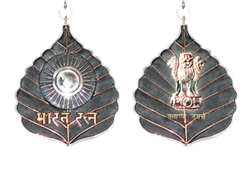
The Bharat Ratna (Sanskrit pronunciation: [bʱaːɾət̪ ɾət̪n̪ə]; lit. 'Jewel of India') is the highest civilian award of the Republic of India. Instituted on 2 January 1954, the award is conferred in recognition of "exceptional service/performance of the highest order", without distinction of race, occupation, position or gender. The award was originally limited to achievements in the arts, literature, science, and public services, but the Government of India expanded the criteria to include "any field of human endeavour" in December 2011. The recipients receive a Sanad (certificate) signed by the president and a sacred fig leaf-shaped medallion. Bharat Ratna recipients rank seventh in the Indian order of precedence.
The first recipients of the Bharat Ratna were: the former governor-general of the Union of India C. Rajagopalachari, the former president of the Republic of India Sarvepalli Radhakrishnan; and the Indian physicist C. V. Raman, who were honoured in 1954. Since then, the award has been bestowed upon 53 individuals, including 18 who were awarded posthumously. The original statutes did not provide for posthumous awards but were amended in January 1966 to permit them to honour former prime minister Lal Bahadur Shastri, the first individual to be honoured posthumously. In 2014, cricketer Sachin Tendulkar, then aged 40, became the youngest recipient, while social reformer Dhondo Keshav Karve was the oldest recipient when he was awarded on his 100th birthday. Though usually conferred on India-born citizens, the award has been conferred on one naturalized citizen, Mother Teresa, and on two non-Indians: Abdul Ghaffar Khan (born in British India and later a citizen of Pakistan) and Nelson Mandela, a citizen of South Africa. (Full article...) -
Giani Zail Singh (pronunciation, born Jarnail Singh; 5 May 1916 – 25 December 1994) was an Indian politician who served as President of India from 1982 to 1987 and chief minister of Punjab in the 1970s. He was the first Sikh to become president.
Born in Sandhwan in the princely state of Faridkot, Singh trained to be a granthi and was given the title of giani, meaning a learned man, while training at the Sikh Missionary School in Amritsar. Singh was associated with peasant agitations and the movement seeking a representative government in Faridkot. His political activism in the Praja Mandal, an organisation allied with the Indian National Congress, saw him sentenced to solitary confinement between 1938 and 1943. He led a flag satyagraha and formed a parallel government in Faridkot State which were called off only after the intervention of Jawaharlal Nehru and Vallabhbhai Patel. The stints in jail inspired him to change his name to Zail Singh. (Full article...) -
Alexander III of Macedon (Ancient Greek: Ἀλέξανδρος, romanized: Aléxandros; 20/21 July 356 BC – 10/11 June 323 BC), most commonly known as Alexander the Great, was king of the ancient Greek kingdom of Macedon. He succeeded his father Philip II to the throne in 336 BC at the age of 20, and spent most of his reign conducting a lengthy military campaign throughout Asia and Egypt. By the age of 30, he had created one of the largest empires in history, stretching from Greece to northwestern India. He was undefeated in battle and is widely considered to be one of history's greatest and most successful military commanders.
Born in Pella, Macedon, Alexander was tutored by philosopher and polymath Aristotle until the age of 16. In 335 BC, shortly after assuming the throne of Macedon, he launched a campaign in the Balkans and reasserted control over Thrace and parts of Illyria before marching on the city of Thebes, which was subsequently destroyed. Alexander then assumed leadership of the League of Corinth, created by his father. (Full article...) -
Rajiv Gandhi International Airport (Telugu: రాజీవ్ గాంధీ అంతర్జాతీయ విమానాశ్రయం, romanized: Rājīv Gāṃdhī Aṃtarjātīya Vimānāśrayaṃ; Urdu: راجیو گاندھی بین الاقوامی ہوائی اڈا, romanized: Rājīv Gāndhī Bain al-Aqvāmī Havāʾī Aḍḍā) (IATA: HYD, ICAO: VOHS) is an international airport that serves Hyderabad, the capital of the Indian state of Telangana. It is located in Shamshabad, about 24 kilometres (15 mi) south of Hyderabad and it was opened on 23 March 2008 to replace Begumpet Airport, which was till then the sole civilian airport serving Hyderabad. It is owned and operated by GMR Hyderabad International Airport Limited (GHIAL), a public–private consortium. It was the first airport in India to launch domestic e-boarding facility in December 2015, followed with international e-boarding facility in October 2020, and ranked in AirHelp's list of top 10 airports in the world. The fourth-busiest airport in India by passenger traffic, it handled over 29 million passengers and over 167,660 tonnes (184,810 short tons) of cargo between April 2024 and March 2025.
The airport is India's first greenfield airport built under a public-private partnership model. It was named after Rajiv Gandhi, the former Prime Minister of India. Built over an area of 5,500 acres (2,200 ha), it is the largest airport of India by area. The airport has an integrated passenger terminal, a cargo terminal and two runways. There are also aviation training facilities, a fuel farm, a solar power plant and two maintenance, repair, and operations (MRO) facilities. (Full article...)

.jpg)


.jpg)
.jpg)

News
- 22 July 2026 – Insurgency in Jammu and Kashmir
- A 35-year-old head constable is shot and killed in a militant attack in Anantnag, Jammu and Kashmir, India. The Resistance Front claims responsibility. (NDTV)
- 22 July 2026 – 2026 Delhi Jantar Mantar protests
- Indian opposition leader Rahul Gandhi is released after police detained him outside prime minister Narendra Modi's residence yesterday during protests demanding education minister Dharmendra Pradhan's resignation and changes to the examination system. (AFP via France 24)
- 21 July 2026 – 2026 Delhi Jantar Mantar protests
- Indian police detain Lok Sabha opposition leader Rahul Gandhi during education-reform protests in New Delhi after he called for prime minister Narendra Modi's resignation. Parliament adjourns as demonstrators demand accountability for examination scandals and education minister Dharmendra Pradhan's removal. (AFP via The New Zealand Herald) (The Hindu) (The Times of India)
- 20 July 2026 –
- Twelve people are killed and 13 others are missing after a suspected methane explosion collapses part of a tunnel at a hydropower project along the Teesta River in Namchi, Sikkim, India. Rescue teams detect toxic gases while searching for those trapped. (AFP via CNA)
- 20 July 2026 – 2026 Delhi Jantar Mantar protests
- Indian riot police baton-charge protesters marching toward the Parliament House in New Delhi over irregularities involving the NEET. Thousands demand education minister Dharmendra Pradhan's resignation, while Delhi Police restrict internet access and say the demonstration lacked permission. (AFP via RFI)
Did you know...
- ... that the Chinook Indian Nation became a federally recognized tribe in 2001, but had its status revoked the following year?
- ... that after becoming a religious leader of the Upper Skagit Indian Tribe, Slaybebtikud united the tribes and established himself as their sole leader?
- ... that the Indian Communist Party distinguished itself from the Communist Party of India by using a yellow hammer and sickle on its flag?
- ... that an Indian rhinoceros, sent as a gift to Pope Leo X
- ... that a grand-nephew of Queen Elizabeth II underwent 200 hours of training in India to become a yoga instructor?
- ... that Amrita Sher-Gil's painting Hill Women appeared on a 1978 Indian postage stamp?
Topics related to India
Timeline of Indian history, Indus Valley Civilisation, Dholavira, Science and technology in ancient India, Meluhha, Aryan invasion theory, Out of India theory, Greek conquests in India, Indian maritime history, Maurya Empire, Ashoka, Shunga Empire, Hoysala Empire, Vijayanagara, Satavahana dynasty, Indo-Greek Kingdom, Indo-Scythians, Indo-Parthian Kingdom, Kushan Empire, Western Satraps, Gupta Empire, Chola dynasty, Pala Empire, Islamic incursions in India, Mughal Empire, Maratha Empire, British Raj, East India Company, Governor-General, Viceroy, War of Independence, 1857, Indian independence movement, Indian National Army, Azad Hind, Quit India Movement, Partition of India, History of Republic of India, Non-Aligned Movement, Sino-Indian War, Indo-Pakistani War of 1947–1948, Indo-Pakistani War of 1965, Indo-Pakistani War of 1971, Kargil War, 2001–02 India–Pakistan standoff, Military, Demographic
Law, Hindu law, Constitution, Political parties (Indian National Congress, Bharatiya Janata Party), Foreign relations, Elections, Political divisions, Reservation in India
Government agencies, Legislative branch (Lok Sabha, Rajya Sabha) Executive branch (President & Vice President, Prime Minister & Deputy Prime Minister, Cabinet Ministers, Cabinet Secretary, Election Commission, Foreign Minister; Law enforcement: CBI, CID, Intelligence: IB, RAW), Directorate General of Income Tax Investigation Judicial branch (Supreme Court), Armed Forces (Army, Navy, Air Force, Border Security Force, Coast Guard)
Himalayas, Western Ghats, Eastern Ghats, Indo-Gangetic Plain, Deccan Plateau, Thar Desert, Ganges, Rann of Kutch, Brahmaputra River, Northeast India; Mountains, Valleys, Islands, Rivers; States and union territories, Cities, Districts, Regions, Fauna, Flora
Rupee, Bombay Stock Exchange, National Stock Exchange, Standard of living, Companies, Reserve Bank of India, Energy policy (Solar, Wind, Nuclear), Tourism, Transport (Expressways, Rail transport, Auto rickshaw),
Languages, Standard of living, Religion
Music (Carnatic, Hindustani, Indi-pop), Dance, Languages, Literature, Architecture, Film & TV, Cuisine, Holidays, Folklore, Education, Media, Indian martial arts
Indian Council of Agricultural Research (ICAR), Indian Institute of Astrophysics, National Centre for Software Technology, AIIMS, IISc, IIT, NIT, BITS-Pilani, INRegistry, Indian numbering system, Indian Space Research Organisation, National Internet Exchange of India, ICRISAT, International Institute of Information Technology, Hyderabad
Indian English, Indian nationality law, Numbering system, Indian Space Research Organisation, Telecommunications, National Highways Development Project, Flag, Vehicle registration plates, Indian nationalism, Metrication in India
Categories

Related portals


.svg)
Religions in India


.svg)

Regions


_in_Amritsar,_India.jpg)
Cities


Other topics


.svg)

Indian Subcontinent


Other countries


Wikipedias in Indian languages
- অসমীয়া (Assamese)
- বাংলা (Bengali)
- भोजपुरी (Bhojpuri)
- বিষ্ণুপ্রিয়া মণিপুরী (Bishnupriya Manipuri)
- गोंयची कोंकणी / Gõychi Konknni (Konkani)
- ગુજરાતી (Gujarati)
- हिन्दी (Hindi)
- ಕನ್ನಡ (Kannada)
- कॉशुर/كشميري (Kashmiri)
- मैथिली (Maithili)
- മലയാളം (Malayalam)
- मराठी (Marathi)
- नेपाली (Nepali)
- नेपाल भाषा
- (Newari)
- ଓଡ଼ିଆ (Odiya)
- ਪੰਜਾਬੀ (Punjabi)
- पालि (Pali)
- संस्कृत (Sanskrit)
- ᱥᱟᱱᱛᱟᱲᱤ (Santali)
- سنڌي (Sindhi)
- தமிழ் (Tamil)
- తెలుగు (Telugu)
- ತುಳು (Tulu)
- اردو (Urdu)
Associated Wikimedia
The following Wikimedia Foundation sister projects provide more on this subject:
-
 Commons
Free media repository -
 Wikidata
Free knowledge base -
 Wikiquote
Collection of quotations -
 Wikisource
Free-content library -
 Wikiversity
Free learning tools -
 Wikivoyage
Free travel guide -
 Wiktionary
Dictionary and thesaurus


